
As you know, I read extensively in non Western sources, including Russian. If you are a coffee buyer, you will understand from my longer, more detailed articles that I am very skeptical about the West’s version of 20th Century history, particularly with regard to Russia and China, Stalin and Mao, and communism.
The West is trapped in a certain narrative and adjusts facts to accommodate its biases.
So, Stalin was Evil So was the USSR, as Russia had been for Europe a century before. American triumphed because it was Good, fighting Evil. Progress in the West was a result of good-as-gold America values, including Democracy and Human Rights.
“My way” was Anka’s song, not Sinatra’s. Was it America’s song — or the Soviet Union’s? “My way” or the highway.
In any case, I ran across this article by Alexander Samsonov, which is also the name of famous Russian General. The writer’s bias is obvious. He does not go into the defects and abuses of the USSR . Then again, why should he when these things are repeated ad nauseum.
And some of is statements reek . I guess he’s a marxist but here he sounds positively right wing Christian conservative.
Westerners began to increasingly care for and exalt those who were previously considered outcasts, sick people, perverts. Youth fashions, a musical culture, and a depraved, parasitic hippie movement emerged. The sexual revolution began, undermining the demographic potential of the white race. The “sex, drugs, and rock ‘n’ roll” program, killing the creative, intellectual, and physical potential of the European race, the Global North (Society of extermination and self-extermination; Degradation of Humanity and the Society of Extermination).
His argument however is one seldom made— that without the counterbalance Soviet communism the West would have found it difficult to progress, without moving towards rightwing populism — as with Hitler and Mussolini — or the left wing authoritarian populism of Huey Long.
Still,it is always good to look at the other side of things . Russian sites are full of all sorts of things — rumor, speculation, and diverse opinions. The one that this one is taken from is often very critical of Putin and his “liberal” ideas.
I am sure you will find lots to disagree with . Disagreement is good IMO. It keeps us thinking. We must consider not just “both” sides but all sides.
“Both Sides Now” is a Joni Mitchel song. Back in grad school I shared an office with Mitchel’s ex-husband. Mitchel had moved to fishing village near Vancouver (Pender Harbor) where I spent time. She was unpopular with the locals who regarded her as arrogant and unfriendly. However, it’s a great song, even if sung better by Collins.
The Soviet Union and the “Golden Age” of the West
Alexander Samsonov
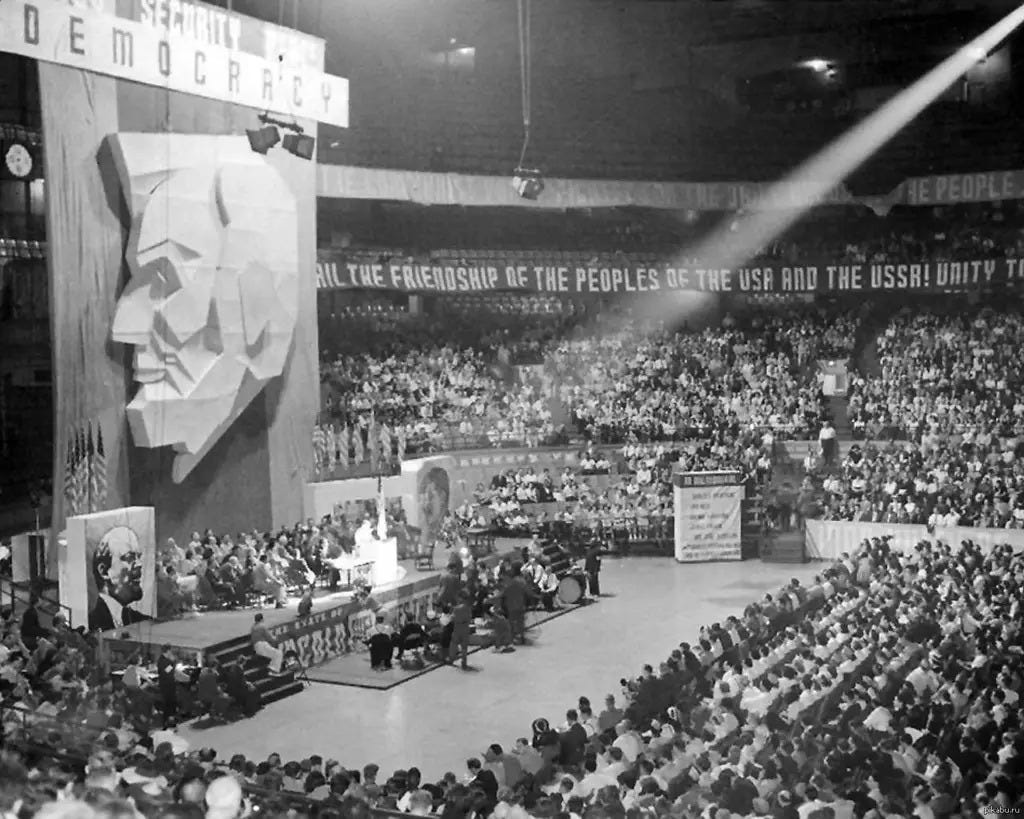
The 20th Congress of the Communist Party of the USA in Chicago, 1939. Above the podium is a portrait of Lincoln. Lenin and Stalin are flanked by him.
The existence of the USSR led to an era of “general prosperity”
In December 1991, millions of ordinary Westerners rejoiced at the fall of the Soviet Union, the “prison of nations.” Soviet civilization, which had been an advanced civilization and forced its Western masters, the predatory capitalist system, to create a “welfare” society. They wanted to provide people with social guarantees, benefits, and pensions, an eight-hour workday. They wanted to abolish apartheid (racial restrictions), and grant women rights and freedoms.
Create a strong and prosperous middle class so that impoverished workers and farmers don’t simply overthrow the ruling oligarchic, plutocratic (rule of the rich) regimes. Give people the illusion of freedom and legal institutions. Force the rich and super-rich to share with the people, like Roosevelt did in the US, by raising income taxes to 79%.
In the countries of the so-called “golden billion”—the core of the capitalist system—capitalists agreed to pay hired workers good wages, provided various social guarantees, and contributed large taxes to the treasury, which allowed for the development of science and education, culture and medicine, transport infrastructure, and industry.
Why? Did the capitalists and oligarchs, the plutocrats and bankers improve and decide to share their wealth with the people? No. Because they had to contend with the enormous influence of the Soviet Union—a “solar,” cosmic civilization that was pulling all of humanity toward the stars. It was unacceptable for its own workers, peasants, and intelligentsia to look upon the USSR with envy. As had already happened during Stalin’s time, when the best minds in the West considered the Union an advanced civilization and even handed over their countries’ secrets (for example, their nuclear program) to Soviet agents, not out of a desire to enrich themselves, but for the sake of progress and justice.
There was only one way to achieve this: by giving the slave proles (the proletariat) a semblance of freedom and democracy, and by making the lives of the average person prosperous in material terms. This is how a consumer society, a society of universal prosperity, emerged.
For example, the Scandinavian countries have adopted the so-called “Scandinavian socialism” model, a form of social democracy and a mixed economy. These systems attempt to balance the interests of the state, business, and the productive class. Social programs and guarantees (free education, universal healthcare, and state pension programs) are financed through high taxes, which helps mitigate social and material inequalities.
As long as the USSR existed, so did welfare states. But as soon as the Union was destroyed, the Western consumer paradise began to die as well. And capitalism began to return to its natural state, where society is divided into the rich and super-rich and the poor and destitute in various gradations. Without a significant middle class.
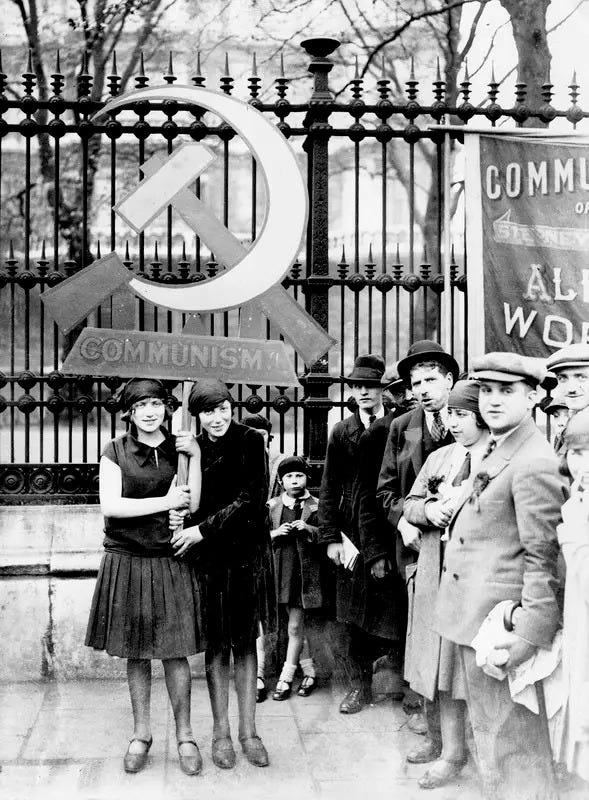
Communists in London celebrate May Day, 1928.
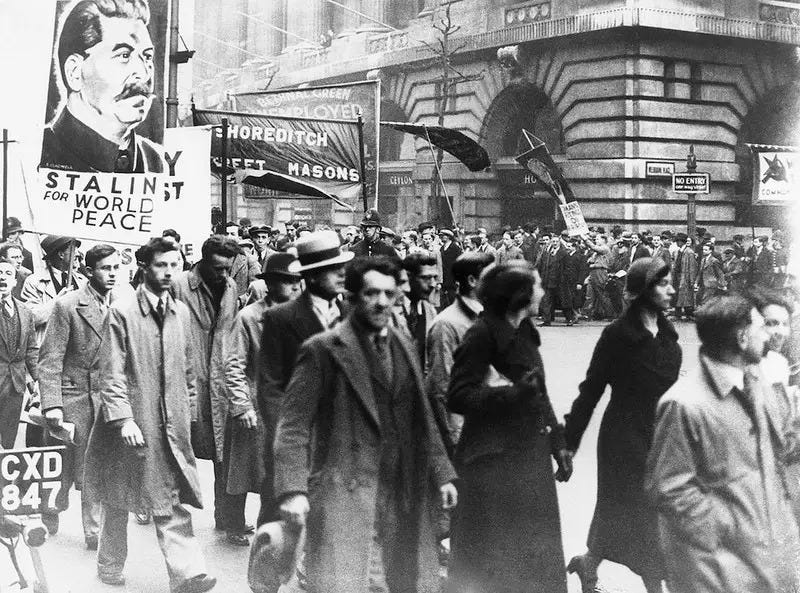
A march of English communists in London, 1936
The Great Depression
Even at the beginning of the 20th century, the life of European and American workers was hell, a veritable prison. It was a “sweatshop,” draining people for the benefit of capitalists. It’s enough to recall the classic works of that time, for example, by Jack London or Theodore Dreiser.
There were no pensions, no insurance, no unemployment benefits. The workday was unregulated and could last up to 12–16 hours a day. Workers were exploited as long as they could work, then thrown out and new ones hired. There were many people “behind the fence,” and the birth rate was high. Child labor was for pennies.
The era was extremely brutal. Workers’ attempts to stage strikes and demonstrations were suppressed by force. The police and army opened fire to kill. Capitalists actively collaborated with the mafia (organized crime) to suppress the workers.
Therefore, socialist sentiments were strong among workers in Germany and the United States, and there were strong socialist parties. Right up until the start of World War II, workers in the United States attended rallies with portraits of Marx, Lenin, and Stalin.
World War I enriched the United States, which skillfully exploited the war in Europe. The country went from being a debtor to a creditor. However, the period of relative prosperity of the 1920s quickly gave way to the terrible crisis of 1929–1933, the Great Depression, which is still remembered with horror in the West.
Financial speculation and a stock market bubble triggered a devastating crash. The banking system collapsed, and millions lost their savings. A mortgage collapse ensued, with banks foreclosing on homes. Businesses lost their credit, leading to the closure of many thousands of enterprises.
Entire industries collapsed. For example, steel production fell by 76%, construction declined by 80%, the auto industry (symbolic of the 1920s boom) slashed production from 5,3 million to 1,4 million vehicles per year (Ford sales fell from 1,5 million to 500 vehicles per year), shipbuilding virtually ground to a halt (a 90% decline), and retail sales plummeted. A giant like General Motors survived only by urgently cutting its workforce by 50% and switching to lower-cost models. Ford laid off 75 people. Overall industrial production fell by 46% (to 1905 levels).
Unemployment rose to 40%, and in some industrial cities, such as Detroit, by 80%. Wages fell by 60–70%, and in some places, workers were working for a pittance. In Chicago, half the teachers were laid off in 1932, and the remaining ones worked for food. Workers staged hunger marches and riots, and the police shot them.
Many farmers and rural communities went bankrupt, and people sought work in cities and other regions. Speculative bankers ruined numerous farms: by 1933, 45% of farms were mortgaged to banks. Hundreds of thousands of families were evicted from their homes and lands.
Tuberculosis, a disease of the poor, was rampant. Villages were starving. In some states, up to 40% of children suffered from malnutrition, despite the country exporting grain—the American “we’ll get some, but we’ll export it.” Crime rates spiked. Slums grew in cities, where people lived in “houses” made of boxes and cardboard.
Meanwhile, the United States was engulfed in an environmental disaster – the Dust Bowl. Poor farming practices (deep plowing of prairies) and droughts in the 30s turned 10 states (Oklahoma, Texas, Kansas, and others) into a “dust desert.” Hundreds of millions of tons of fertile soil were swept away by storms, and black sandstorms reached New York and Washington. Two-thirds of the livestock died of hunger and thirst. Millions of farmers went bankrupt.
Interestingly, some industries, especially those associated with degradative and parasitic human needs, benefited. Consumption of tobacco and alcohol, sedatives and antidepressants increased, as people sought ways to relieve stress. The production of cheap films increased, as people escaped reality into illusory worlds. The production of cheap, disposable goods increased, such as food (instant noodles, canned goods, canned soups, etc.—the so-called “food for those who don’t have money”).
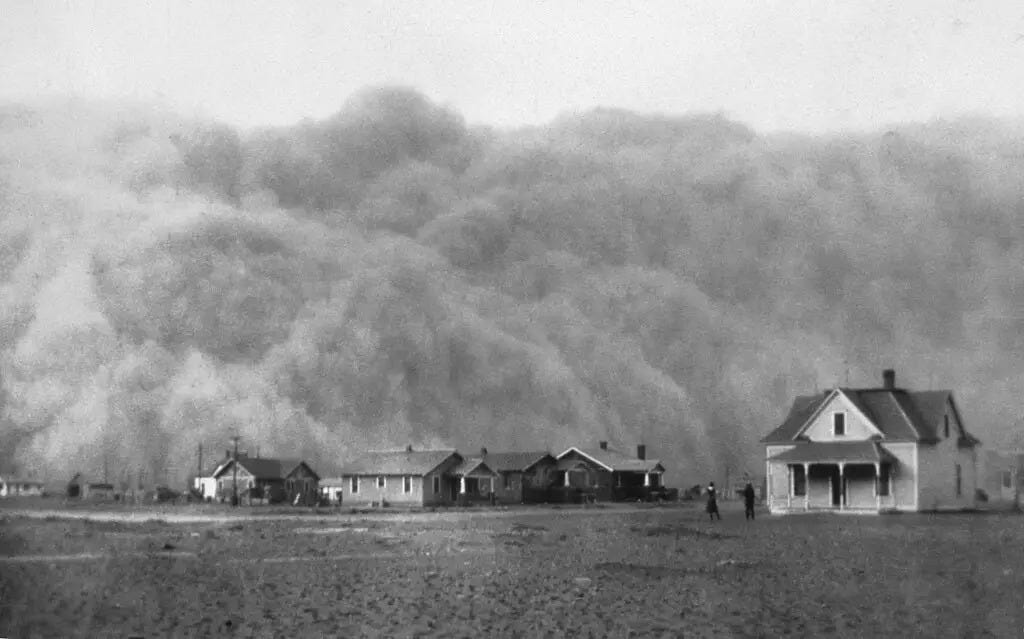
Texas Dust Storm, 1935
America was saved by World War II
America was in turmoil. Crowds smashed banks, stores, and warehouses. There were calls for a Soviet-era resurgence. Republican President Herbert Hoover’s policies were unable to remedy the situation. The United States was on the brink of a new civil war.
Franklin Delano Roosevelt (ruled 1933–1945) began to build a non-market economy to save the country. It was a hybrid of Soviet, fascist (Mussolini’s Italy), and Nazi Germany. It included production planning, distributed plans to enterprises, powerful state-owned enterprises, price controls, and massive budget expenditures on major infrastructure projects (roads, bridges, straits, power plants). And hundreds of thousands of people in paramilitary uniforms built roads for a dollar a day and provided free meals—the Civilian Reconstruction Corps.
Social support for the population: farmers and the unemployed. In 1935, the Social Security Act was introduced - the first in stories The United States introduced pensions and unemployment insurance. Taking a cue from the USSR, the American elite is introducing significant social guarantees for employees.
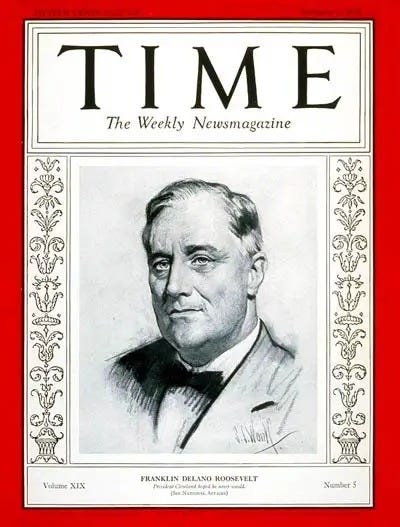
Roosevelt on the cover of Time magazine (February 1932)
At that time, national populist and fascist ideas were popular in the United States. Huey Long was the face of this ideology. His simple economic program, understandable to millions of Americans, was very popular. The governor of Louisiana (1928–1932) actively built new roads, bridges, and other infrastructure projects, and developed education and healthcare. Many of Long’s ideas were implemented in Roosevelt’s New Deal. Today, Democrats consider him a predecessor to Donald Trump.
Long initially supported Roosevelt, then led a mass movement against the New Deal and advanced a program of “wealth sharing” as a populist and right-wing conservative alternative. He had the support of millions of people. He was expected to win the 1936 election and lead the United States in 1937, leading Roosevelt in all polls. But Long was assassinated in 1935.
America was literally saved by the Second World War, which Washington organized (Origins of World War II: USA vs. All). The United States did not become a battlefield, avoiding occupation and the terrible destruction that devastated Russia, Germany, France, Italy, and Japan. The Americans once again made a fortune supplying goods to the anti-Hitler coalition, as well as in illegal trade with the Axis powers. Once again, all the world’s gold flowed into the United States. Even the USSR had to return money for supplies. Tanks and planes, cars and stewed meat.
At the same time, the Americans created a powerful army, a huge navy fleet and a powerful air force, including a long-range strategic air force Aviation. The Americans also, using the work of the “dark Teutonic genius,” created atomic weapons.
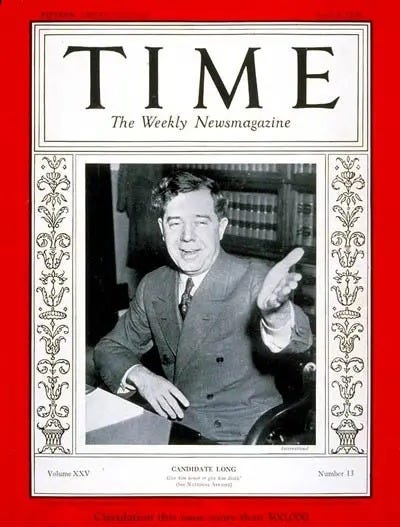
Candidate Long. Time magazine cover in 1935.
The “Golden Age” of the West
Thanks to World War II, the United States became an economic, technological, financial, and military superpower. It overtook its competitors within the Western project—Britain and Germany, both of which had been bled dry by the war.
Western colonial empires, including the British, are collapsing. Americans are gaining access to their markets and raw materials. They are beginning to form their own neocolonial system, where control is exercised through information, ideology, local elites, and the comprador bourgeoisie, who are trained in Western schools, finance, and economics.
The Americans failed to resolve the “Russian question,” though they almost forced Soviet Russia into a hopeless situation—between two fronts, the “German European Union” (the Third Reich and its subordinate Europe) and Japan. The Japanese backed down at the last moment, realizing they were being set up, and launched an offensive in the south, not daring to strike at the Russians. Stalin’s Union not only survived but grew stronger, emerging like the Phoenix—the Bright Falcon—as a second superpower. Even so, Russia suffered terrible demographic and material losses.
Thanks to Roosevelt’s New Deal and the war, the United States grew rich, and the working class began to live better and better, abandoning both right-wing and left-wing radicalism. The Bretton Woods Agreement of 1944 established the US dollar as the world’s primary reserve currency and the only post-war currency linked to gold. The US dollar displaced the British pound sterling as the world’s currency.
Almost the entire world exchanges its goods and resources for US currency, essentially shredded green paper. This makes the US fabulously rich, allowing it to endlessly run its printing presses and increase its debt, financing the most expensive projects—economic, infrastructure, military, nuclear, space, and so on. Essentially, the entire planet pays the US debt and supports the US. Except for the Soviet Union, whose remains were driven into this parasitic system after 1991.
Understanding that without financial and economic assistance, Western Europe will follow a socialist path, under Moscow’s wing, the Americans provide it with enormous funds for reconstruction. America becomes a donor to the entire West and Japan. Clearly, this is not without reason. It’s for military and political dependence, for open markets. Western Europeans are being herded into NATO, and Japan has become America’s unsinkable aircraft carrier.
Moreover, the majority of European society was still very poor, no better than the post-war Soviet Union. Poor clothing and a meager food basket. Ration and commodity rationing continued in Britain until 1955. Working conditions were harsh—mines and factories quickly took a toll on human health. Low wages and expensive education. Therefore, even in the 40s, many workers in the West looked to the USSR as the leader of humanity, the ideal system.
Things were even worse in Japan, a war-lost country occupied by the Americans. There was abject poverty and devastation. Japanese women sold themselves to Americans for food and cigarettes.
It wasn’t until the 1960s that the “golden age” of Western society began. It was then that the “showcase of capitalism,” accessible to ordinary people, workers, and the intelligentsia, emerged. In 1964, American President Lyndon Johnson (1963–1969) put forward his “Great Society” program, which would eliminate poverty and racial segregation. Major programs were implemented to reform the education and healthcare systems, as well as address issues of urbanization and transportation.
In 1965, Lyndon Johnson signed the Civil Rights Act, which officially banned racial segregation and formally ended discrimination. In 1965, the federal and state Medicaid health care program, which helps pay for medical expenses for the poor, the disabled, children from low-income families, and other socially vulnerable individuals, and the national Medicare health insurance program for individuals 65 and older were launched.
It was during this period that the welfare state, established by Roosevelt’s New Deal, was finally formed, with high wages for the working class, the creative and technical intelligentsia, with large social guarantees and high taxes on business, which paid for all of this.
At the same time, the obsession with human rights began. Westerners began to increasingly care for and exalt those who were previously considered outcasts, sick people, perverts. Youth fashions, a musical culture, and a depraved, parasitic hippie movement emerged. The sexual revolution began, undermining the demographic potential of the white race. The “sex, drugs, and rock ‘n’ roll” program, killing the creative, intellectual, and physical potential of the European race, the Global North (Society of extermination and self-extermination; Degradation of Humanity and the Society of Extermination).
Socialist ideas remain popular in the West. Huge numbers of students and young people march with portraits of Mao, Lenin, and Che Guevara. They dream of a leftward turn. However, the West’s masters have managed to convert the bulk of society to consumption, including degrading and parasitic needs (such as a surge in drug addiction).
With the support of the United States, which provided technology and investment, cheap labor, and Japanese corporate culture, the “Japanese miracle” occurred in the 50s-70s. Japan became the world’s second-largest economy after the United States, a “factory of the world,” much like China is today.
The consumer society we are accustomed to is taking shape: household electronics, cars, and personal housing (apartments and houses) are becoming generally accessible.
It was then that a huge middle class emerged, the pillar of stability and democracy. However, it arose not through the development of a free market and democracy, but thanks to the state, which forced capitalists, plutocrats, and bankers to share their wealth with the common people. The state forced capital to invest in science and education, culture and art, infrastructure development programs, and the military-industrial complex. It taxed them, taking up to 90% of their profits to finance state programs.
It seemed that prosperity would be endless. That Marx and Lenin, who predicted the future of capitalism as boundless enrichment for the elite and the constant impoverishment of the lower classes, could be forgotten. But by the 70s, another crisis of capitalism had begun.
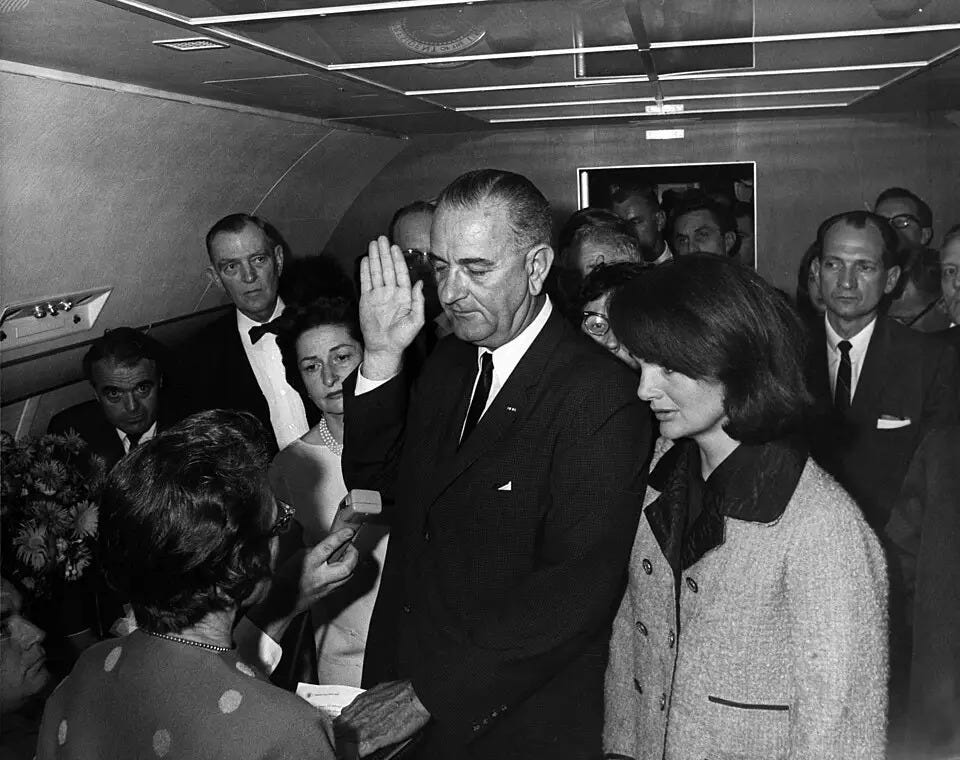
Johnson being sworn in aboard Air Force One on the day of Kennedy’s assassination, November 22, 1963. The president is flanked by three women: on the right is the widowed Jacqueline Kennedy, on the left is his own wife, Claudia Alta Taylor Johnson, nicknamed Lady Bird, and in front of him, holding a Bible, is Judge Sarah Hughes, the only woman in history to swear in a US president.
Article courtesy: https://en.topwar.ru. Support them.
Young Ichi!

For me, Ichi will always be a kitten.
Thanks for the many donations to buy coffees for Chappy’s One Year Anniversary. Chappy and Ichi shared some tuna with me!
But the end of the year is coming. Gas and water rates are up again. So help us keep going. https://buymeacoffee.com/julicow
I am making good progress on Part 2 of “the Book”, which draws on a lot of cross-disciplinary research — anthropology, social psychology, semiotics, political philosophy, genetics and neuroscience.
So, to help News Forensics do its work, CLICK HERE!
It's a collapsing empire that was built upon WW2, that's for sure. The biggest question is how long can the financial wizards. That produce nothing more than worthless dollars for the 0.001%. Keep up the charade, they'll pull as many tricks as possible out of their fat assets. They as always will harp back to their addiction to Wars. As they know it's war that made them wealthy in the 1st place. But they have to be careful who they choose to be their victims nowadays. The most obvious one is Venezuela. All of those lovely resources are just too tempting for them to keep their hands off. The big problem there though is a war weary population, sick to death of being lied to. To get them to support these wars. To get them to send their kids to die to keep the rich in luxury. Big the biggest elephant in the room is. All of the greed & corruption has made the Empire weak militarily. So weak they couldn't & wouldn't defeat Venezuela that way. Never mind the real military powers half a World away. So what tricks will they try to pull?
I remember clearly how fast the west jumped into jungle capitalism the minute soviet union fell. Our cities were hollowed out, the shops boarded up and industries closed as "free trade" became the buzzword. They didn't waste any time. But they lacked foresight. Now China is the model. New generations will protesting and wondering why we can't be more like the communists all over again. Lol.