Zelensky's new fall guy
Nothing new

As promised, I will show you an example of simple questioning to get facts from an LLM. . The LLM output is very long — but there is a LOT of information although some of it is repetitive and the LLM really, really wants to default to propaganda!
I wanted to get information about Zelensky’s new Commander-in-Chief, replacing Syrsky. who was at odds with the popular Defense Minister, Fedorov. Zelensky fired Fedorov triggering massive protests. So, Zelensky then fires Syrsky. appointing Mykhailo Drapatyi (a Fedorov supporter)( as the new Commander-in-Chief and Yevhen Khmara as the new Defense Minister.
Musical chairs?
This new appointment had, on the surface of it, little to do with military competence — just local politics.
Syrsky was a failure but a lot of that had to do with just following orders from Zelensky.
Drapatyi has a long list of failures as well. But he is immensely popular as Fedorov’s stand-in. That said, there is nothing much he can do BUT follow orders just like previous commanders.
Unless, of course. Fedorov can carry out Maidan 2.0.
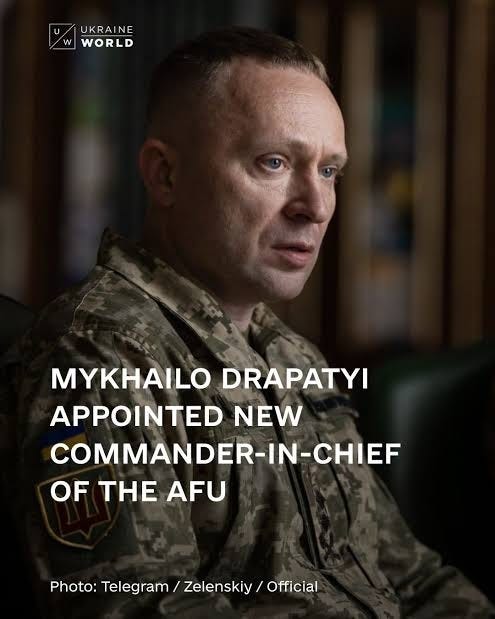
I first started my queries getting the LLM’s consensus view - -which is the Ukrainian view plus CSIS .
Drapatyi was presented as the Second Coming of Christ.
But Kiev is doomed militarily. Russia has closed down its ports in the south, destroyed logistical support, locomotives, railines, gas stations, trucking. Ukrainian casualties are more than 2 million, 32 KIA for every Russian. Drapatyi will,as Sysky did, follow orders — but he will take the blame when Ukrainian efforts fail, as they will surely.
Russia is moving inexorably to take the Slavyansk - Kramatorsk conglomeration. And making gains in Kharkiv and Sumy. Most important General “Armageddon” Surovikin is back.
In any case, Drapatyi is a Fall Guy.
I didn’t give you the consensus view — that’s easy to find in the MSM.
Below, LLM output:
Drapatyi— analyze this new commander-in-chief using only information from Russian sources. Do not include caveats from CSIS or Ukrainian sources.
Russian state media and military bloggers characterize Mykhailo Drapatyi as a hardline “Nazi” and “Russophobe” who harbors a consistent animosity toward Russia.
Russian Media Framing
2014 Mariupol Footage:
Russian war correspondents and bloggers heavily circulate archival video footage of Drapatyi from Mariupol in the spring of 2014, presenting it as core evidence of his hostile stance
Intent to Harm:
These commentators argue that his past actions demonstrate a permanent hostility, asserting he will operate without moral constraints in combat.
Retaliatory Actions and Claims
Targeting and Data Leaks:
Russian state reports claim that law enforcement channels have acquired personal data belonging to Drapatyi, including residential addresses, phone numbers, and email contacts.
Casualty Allegations:
Russian outlets frequently accuse forces under Ukrainian leadership of conducting intensive artillery and missile strikes on populated areas in the Donetsk and Luhansk regions.
”He hates us — and hates consistently.”
The Telegram channel “Operation Z: Russian Spring War Correspondents” reacted emotionally to the news of Mykhailo Drapatyi
Russian authorities allege that Ukrainian forces under Drapatyi conducted more than 70 strikes on Russian-occupied areas of Donetsk and Luhansk between 2014 and 1919.
Accusations of russophobia, cruelty, incompetence
Following the appointment of Mykhailo Drapatyi as Commander-in-Chief of the Armed Forces of Ukraine, Russian state media, law enforcement bodies, and military bloggers formalized specific accusations focusing on his background.
Russian sources detail these elements across three primary categories:
Accusations of Russophobia; Ideological Hostility:
Russian military bloggers and commentators characterize Drapatyi as a fundamental “Russophobe” who possesses a deep, generational animosity toward Russia.
Consistency of Motive:
Russian Telegram channels state that “he hates us—and hates consistently,” framing his ideological drive not just as strategic opposition but as personal, deep-seated hatred.
Archival Framing: Media outlets utilize historical footage from his actions in Mariupol in 2014 to build an administrative profile of a commander inherently hostile to Russian interests and regional influence.
Accusations of Cruelty / Civilian Shelling:
The Investigative Committee of the Russian Federation leveled formal criminal charges against Drapatyi in absentia, alleging that forces under his command intentionally targeted residential areas.
Casualty Responsibility:
Russian law enforcement explicitly attributes 154 civilian casualties (both killed and wounded) in the Russian-occupied parts of the Donetsk and Luhansk regions to military operations directed by Drapatyi between 2017 and 2019.
Over 70 Strikes:
Russian state media reports assert that he personally authorized and coordinated more than 70 prohibited artillery and missile strikes against populated non-military zones.
What do russians present as proof?
To back up their criminal charges against Mykhailo Drapatyi, the Investigative Committee of the Russian Federation (SKR) and Russian state media put forward a specific set of administrative evidence, forensic claims, and field data.Because the trials are conducted in absentia (in the defendant’s absence), the Russian legal system relies on material compiled from local proxy authorities and military tracking.
Russian bodies present the following primary items as “proof”:
1. Military Command Logs and Operational OrdersChain of Command Documentation:
The Investigative Committee cites captured or monitored operational logs establishing that Drapatyi held direct command over the 58th Separate Motorized Infantry Brigade (starting in 2016) and later co-led the Joint Forces Operation (JFO) alongside Viktor Nikolyuk between 2017 and 2019.
Authorization Proof:
Russian prosecutors present these deployment registries as legal proof that any artillery, mortar, or missile systems firing from Ukrainian positions during those dates were executing his direct tactical orders.
2. Fragmentation and Ballistic Material Shell Fragments:
Local investigators from the Russian-controlled parts of Donetsk and Luhansk claim to have recovered specific shell and rocket fragments from craters in residential impact zones
Caliber Verification:
Russian state outlets state that forensics on these fragments match heavy weapon calibers prohibited by the Minsk Agreements (such as 122mm and 152mm artillery). They present this ballistic tracking to legally tie the weapon types directly back to the specific Ukrainian brigades Drapatyi was commanding at the time.
3. Impact Registry and Damage Assessments—70 Documented Strikes:
The Russian Ministry of Internal Affairs references an official legal registry detailing more than 70 distinct artillery bombardments hitting populated non-military zones.Infrastructure Mapping: To satisfy the charge of “using prohibited means and methods of warfare,” Russian authorities submit municipal real-estate damage reports, photographs of destroyed homes, and utility damage assessments from the Donbas as physical proof of non-military targeting.
4. Casualty Testimony and Medical Records /154 Victim Dossiers:
Russian law enforcement maintains a database of 154 specific civilian casualties (including both fatalities and injuries) recorded during his periods of regional command.
Witness Depositions:
The Investigative Committee incorporates formal depositions and video testimonies from local Donbas residents, as well as coroner reports and hospital treatment records, using them in court to legally link civilian suffering to the timeline of Drapatyi’s artillery deployments.
Criminal Database Listing:
Based on these claims of indiscriminate violence, the Russian Interior Ministry officially placed Drapatyi on its federal wanted list immediately following his mid-2026 promotion.
Of course Kiev calls all this “propaganda”!
Assessments of Incompetence vs. Capability
Varying Blogger Perspectives:
Unlike the unified stance on his alleged cruelty, Russian military analysts and bloggers express divided views on his competence.
The “Soviet Style” Critique:
Some commentators attempt to downplay his operational capability by grouping him with a broader critique of Ukraine’s command structure, labeling it as rigid or incapable of shifting away from outdated Soviet tactical dogmas, despite propaganda claiming the opposite.
Warnings of Battlefield Danger:
Conversely, prominent Russian war bloggers (such as the author of Zapiski Veterana) openly challenge the narrative of incompetence.
They warn domestic audiences that Drapatyi is a highly energetic, dangerous, and adaptive battlefield commander who gained his career advancement directly through active combat conditions rather than peacetime politics.
Quick Summary *
Russian sources, specifically state-controlled media outlets like Sputnik and prominent pro-war military correspondents, assert that Mykhailo Drapatyi has suffered critical battlefield failures in the Donbas.
Following his promotion to Commander-in-Chief in July 2026, Russian narratives formalized several specific allegations of operational failure:
The Loss of Pokrovsk (Krasnoarmeysk)
Failure to Hold the City:
Russian outlets focus heavily on Drapatyi’s failure to maintain control over the strategically vital city of Pokrovsk (referred to by Russian sources by its Soviet name, Krasnoarmeysk).
December 2025 Defeat:
Reports from Russian state media emphasize that despite his tactical efforts to anchor the defense, Russian forces successfully “liberated” the city on December 1, 2025.
High Attrition:
Russian military bloggers frequently highlight that Ukrainian forces suffered massive personnel and equipment casualties during the Pokrovsk defense under his guidance.
Accusations of “Meat Assault” Tactics / Costly Frontline Orders:
Russia media have dubbed Drapatyi a “failure-prone general,” arguing that his tactical playbook relies on sending waves of troops into unsustainable defensive positions.
Inability to Halt Advances:
Russian military analysts argue that his reliance on high-casualty counter-attacks ultimately failed to stop the steady momentum of the Russian army’s offensive across the Donetsk region.
Notable Failures
The Kharkiv Sector Retreats (Autumn 2025)
When Drapatyi was appointed to head the Kharkiv sector in October 2025, pro-Kremlin commentators claimed his deployment was an operational failure from the start.
Territorial Losses:
While Ukrainian sources framed his mission as a stabilization effort, Russian mil-bloggers argued that forces under his command failed to hold vital border fortifications, allowing Russian troops to steadily push deeper into the “grey zone” and secure tactical positions across northern Kharkiv Oblast
The Dnipropetrovsk Assembly Disasters:
During his tenure as commander of the Ground Forces, Russian state media heavily weaponized two separate, devastating Russian ballistic missile strikes on Ukrainian training grounds in Dnipropetrovsk Oblast.
Failure of Operational Security:
Russian military analysts blamed Drapatyi directly for a massive failure in operational security, claiming he allowed large concentrations of troops to assemble in the open. The catastrophic strikes, which killed at least 12 soldiers and wounded over 60 in June 2025, forced him to publicly offer his resignation. Russian outlets framed this not as accountability, but as an admission of severe administrative incompetence.
Exhaustion of the Khortytsia Strategic Reserve
Russian war correspondents report that while commanding the Khortytsia Operational-Strategic Group, Drapatyi repeatedly failed to stabilize flanking operations around Toretsk and the Siversk protrusion.
Squandering Matériel:
Telegram channels claim that his doctrine of launching localized, high-casualty infantry counter-attacks failed to plug frontline gaps and instead rapidly depleted Ukraine’s limited armored reserves and elite personnel.
Overextension of the Southern Lines (Early 2024)
While Drapatyi initially received credit for his role in the 2022 Kherson counteroffensive, Russian military bloggers argue that his subsequent defensive deployments in the south during 2024 were a failure.
They claim his inability to establish deep, layered fortifications allowed Russian forces to systematically roll back Ukrainian gains on the left bank of the Dnipro River, rendering previous Ukrainian sacrifices meaningless.
Anticipation of a Failed Summer Offensive
The “Scapegoat” Narrative:
Russian war correspondents, such as Alexander Sladkov, note that Drapatyi’s recent assignment to lead the Khortytsia operational grouping in the Donbas places him in an impossible position.
Premature Claims of Success:
Russian media frames recent Ukrainian tactical actions in the Donbas “grey zone” as heavily overblown failures. They argue that political factions in Kyiv are setting Drapatyi up to take the blame for broader systemic military failures in the east.
Do Russian milly bloggers accuse him of Azov sympathies?
No, Russian military bloggers do not explicitly focus on accusing Mykhailo Drapatyi of having “Azov sympathies.” Instead, they target him directly, framing him as an independent, hardline ideological enemy.
Rather than linking him secondarily to the Azov movement, pro-war Russian channels and state media structure their attacks around the following distinct points:
Primary Labeling: a “Nazi” and “Russophobe”:
They argue his personal hostility toward Russia is deep-seated and foundational, rather than derived from specific external factions like Azov.
Bloggers heavily rely on archival video from the spring of 2014 showing Drapatyi’s BMP armored vehicle breaking through a pro-Russian barricade in Mariupol which predates the broader prominence of the Azov Regiment in that region. They present it as proof of his mentality.
The Context of the Commander-in-Chief Race
Rivals, Not Allies:
In the lead-up to his July 2026 appointment, Russian monitoring of Ukrainian command changes noted that Drapatyi was chosen from a shortlist of 11 candidates.
Distinct Entities:
Russian analytical channels explicitly separated Drapatyi from the Azov movement during this process, noting that he beat out actual Azov-affiliated leaders—such as Azov National Guard Corps Commander Denys Prokopenko and 3rd Assault Brigade (historically linked to Azov) Commander Andriy Biletsky—to secure the Commander-in-Chief position.
Consequently, Russian military bloggers view Drapatyi as a formidable, highly aggressive opponent in his own right, famously declaring, “Unlike [former Commander-in-Chief] Syrskyi... Drapatyi genuinely hates us,” without needing to filter that hostility through an Azov narrative.
If he fails, how will Zelensky use this?
From the perspective of Russian state media, geopolitical analysts, and pro-war military commentators, Volodymyr Zelensky will utilize a potential failure by Mykhailo Drapatyi as a political shield to deflect blame, manage public unrest, and consolidate his personal control over the state apparatus.
Following Drapatyi’s July 2026 promotion amidst massive domestic protests, Russian sources argue that Zelensky has structured the appointment to yield specific political advantages if the battlefield situation worsens.
Shifting the Blame (The “Scapegoat” Strategy)
Deflecting Public Anger:
Russian analytical outlets, such as Voennoedelo, explicitly state that Drapatyi is being positioned to become the ultimate “scapegoat” for the Ukrainian army’s systemic failures. By appointing a general who was actively demanded and cheered by the public and frontline soldiers, Zelensky ensures that any future territorial losses or failed operations will be blamed on the general’s strategy, rather than the president’s political directives.
Absolving the Political Leadership:
Russian war correspondents argue that if the front lines collapse further, Zelensky will frame the defeat as an operational failure by the military high command. This allows the presidential administration to distance itself from unpopular battlefield outcomes.
Neutralizing a Potential Political Rival /Damaging a Popular Figure:
Russian commentators note that Drapatyi enjoys immense, organic popularity among Ukrainian civil society and rank-and-file soldiers.
State media suggests that by thrusting him into an incredibly difficult operational environment, Zelensky effectively burns through Drapatyi’s political capital.
Eliminating Alternate Power Centers:
If Drapatyi fails, his reputation as a “miracle worker” and a morally accountable leader will be tarnished.
Russian analysts claim this serves Zelensky’s goal of preventing any high-ranking military officer from translating battlefield popularity into a future challenge to the presidency.
Justifying Draconian Domestic Policies
Enforcing Stricter Mobilization:
Russian state commentators argue that a high-profile failure under Drapatyi will be used by Zelensky as a rhetorical weapon against the Ukrainian public.
The administration can argue that even a highly popular, reform-minded general cannot win without more manpower, using the failure to justify deeply unpopular expansions of the draft and harsher mobilization crackdowns.
Quelling Protests:
Russian media notes that Drapatyi was appointed to pacify a dangerous domestic political crisis.
If he fails, the presidential administration can argue to the public that street protests and demanding leadership changes during wartime only disrupt the front, thereby discouraging future public demonstrations.
Reshuffling and Financial Consolidation / Tightening the Grip on Funding:
Russian analysts assert that personnel shakeups allow Zelensky to continually cycle through leadership to keep the military compliant.
A failure by Drapatyi would provide an immediate pretext for another sweeping purge of the General Staff, allowing Zelensky to place hyper-loyalists in charge of defense ministry spending and Western financial aid flows.
I haven’t put in all my questions, just a few to indicate how manipulate the LLM’s algorithms. Sadly, you still get omissions and curated responses that can be misleading Yet it is still informative
Support New Forensics.
Help Ichi and Chappy and their human kitten Julian.

I would really like to get to 5000 subscribers. If you like my work, share the urls on other blogs and sites and in comments on podcasts.
Show us you care by buying us coffee at https://buymeacoffee.com/julicow
Just for fun.
Drapatyi's name is derived from "драпать" (drápat') "... which is a colloquial, somewhat slangy verb that means "to run away," "to flee," or "to skedaddle". It is usually used to describe a sudden, hasty, or cowardly escape."
Not a good name for a general.
Drapaty has said in a public media yesterday or the day before that the Russian nation does not have a right to exist. And the first attack under his command was on a family recreation center in Kyrilovka.