Discombolated War Stories....
Postol, Discombobulators, and War Cats

Ted Postol has a very interesting interview. Ted Postol, as you know, has been very prominent, criticizing US narratives regarding weapons systems. He was one of the first to pooh-pooh the West’s fake “Sarin” attack, although one hardly needs a PhD to figure that one out.
Here’s what Wikipedia says about him:
Postol received his undergraduate degree in physics and his PhD in nuclear engineering from MIT. Postol worked at Argonne National Laboratory, where he studied the microscopic dynamics and structure of liquids and disordered solids using neutron, X-ray and light scattering techniques, along with molecular dynamics simulations. He also worked at the Congressional Office of Technology Assessment, where he studied methods of basing the MX missile, and later worked as a scientific adviser to the Chief of Naval Operations.[
After leaving the Pentagon, Postol helped to build a program at Stanford University to train mid-career scientists to study weapons technology in relation to defense and arms control policy.
Now that you know he can read and write, I’ll stop there.
Postol is , shall we say, “informed” which is a lot more than you can say for most of the people running things in the US military or government. That’s where the ability to read and write comes in.
Shall I mention the name “Hegseth”?
Or (General) Dan Caine, Chairman of the Joint Chiefs, boasting a BA in economics and an MA in Air Warfare. How you get a Master of Arts in this field, I don’t know. Guess it’s about learning to “fly a desk”, which is a real term in the US military. .
Martyanov often roasts US military “education” as long on theory and short on technical skills. Caine’s focus is really war as business — not war as combat.
He was an F16 pilot with the National Guard, protecting Washington after 9/ 11. But he didn’t see combat. Later , he joined Shield Capital, a venture capital firm and became a a partner at Ribbit Capital and an advisor for Thrive Capital. Yes, war as business.
Of course, Martyanov is irascible. He likes to criticize.
He criticizes Postol too for relying too much on Western academic studies—which is natural enough— because he doesn’t read Russian or Chinese – and has spent a lot of time at Stanford, despite complaining a lot about its orthodoxies.
Stanford really is a joke.
But Postol lives and breathes American academia so he has to be rather conservative in his analyses.
For example, his assessment of Oreshnik - which Martyanov objected to.
Postol was simply going on conventional wisdom in US academia that the kinetic force of a hypersonic warhead hitting at Mach 10 would technically disperse at the point of impact. But Russians, however, insist that Oreshnik has deep penetrative capabilities thanks to metallurgical developments and other innovations that allow its warheads to penetrate deep into the ground.
Here are the main points (using LLM queries)
1. Kinetic Energy as the Primary Mechanism
The Oreshnik’s warheads are believed to be inert (non-explosive) or “kinetic kill” sub-munitions. Because they re-enter the atmosphere at hypersonic speeds (reportedly Mach 10 or higher), the Formula for Kinetic Energy () dictates that velocity is more critical than mass.
Result: Upon impact, the sub-munitions behave like “rods from god,” liquefying soil and concrete through pure speed rather than a chemical explosion.
2. Hyper-Velocity Soil Displacement
At speeds exceeding 2–3 kilometers per second, the physical properties of the ground change. The impact creates a high-pressure shockwave that displaces earth faster than the material’s structural integrity can resist. [5]
This allows the “darts” to penetrate tens of meters into the earth to reach command centers or silos that are protected against standard surface-level nuclear or conventional blasts.
3. The MIRV “Saturating” Effect
By deploying multiple sub-munitions simultaneously, the Oreshnik can:
Overwhelm Active Defenses: Modern Intercontinental Ballistic Missile (ICBM) defense systems struggle to track and intercept multiple hypersonic objects arriving at steep angles. [
Create a “Cratering” Network: Multiple impacts in a concentrated area can structurally weaken the “cap” of an underground facility, ensuring that subsequent or simultaneous strikes reach the intended depth.
Thermal and Plasma Shielding
At these speeds, the air around the warheads turns into plasma, which complicates radar tracking and provides a thermal barrier. This ensures the projectile maintains its structural integrity until the moment of impact, maximizing the energy transferred into the “deep” target.
There are arguments against all these points– naturally—but the “proofs” are all disputable. The US is a generation behind in hypersonics and the advanced metallurgy needed for them.
Nobody can innovate except us, right? . And who cares if it actually works? So American academics in the field put Russian innovation down to now ancient Soviet research, which is to say, it isn’t innovative at all.
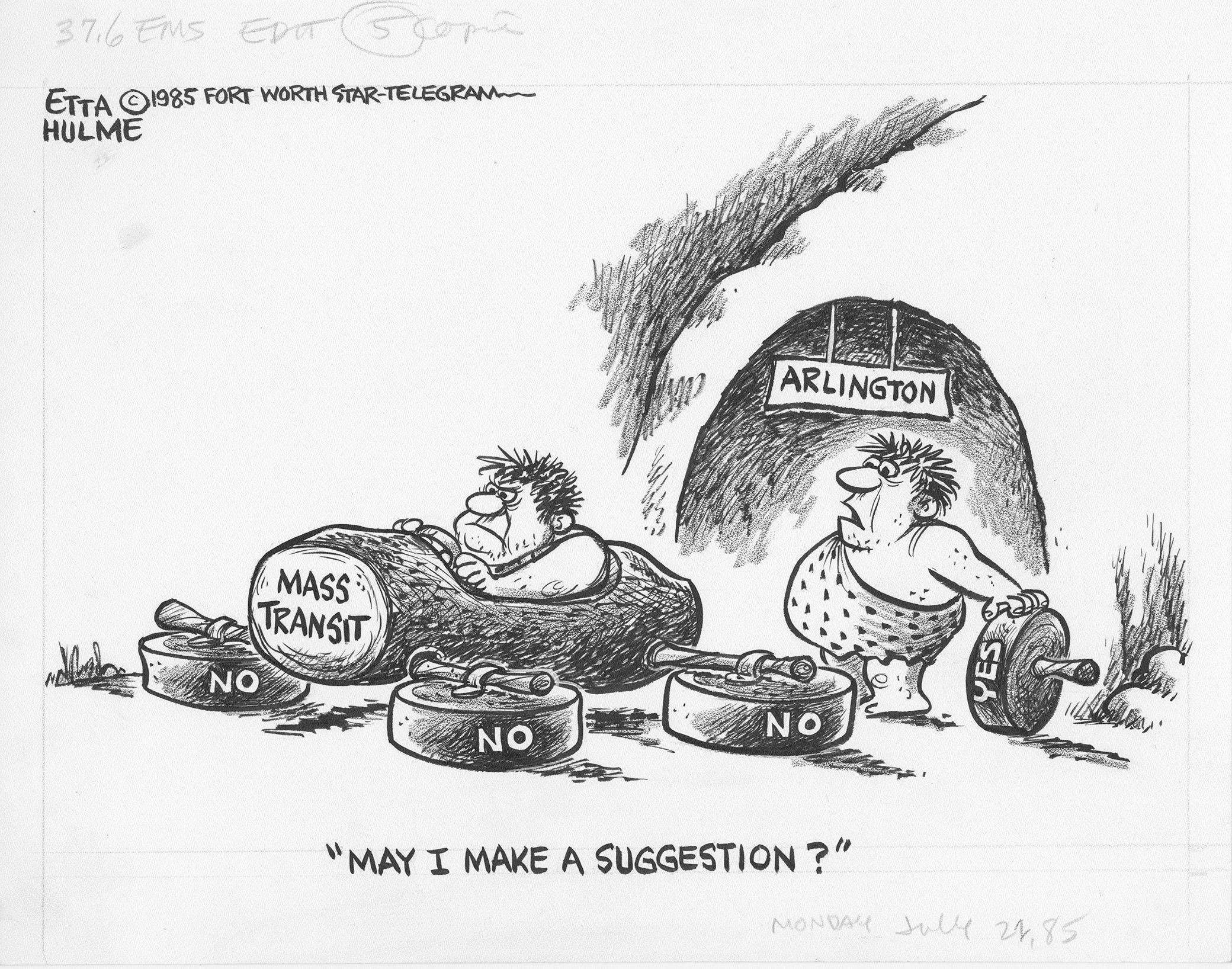
When Postol publishes – it’s in the West-- where they are still working on the Wheel - so he must err on the conservative side.
You will see this in the interview with Nima.
His arguments about the difficulties of obtaining precision with ballistic missiles reflect this orientation,
From the video…..
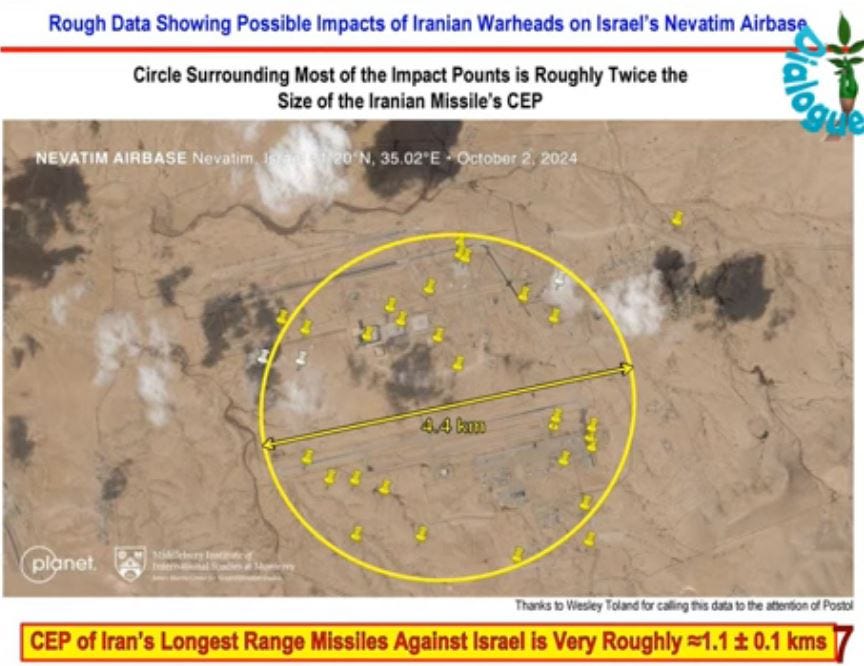
This image indicates at the face of it a rather large CEP (Circular Error Probability) . But this was the 2014 strike using Fattah 1 and Kheibar missiles.
But in 2025?
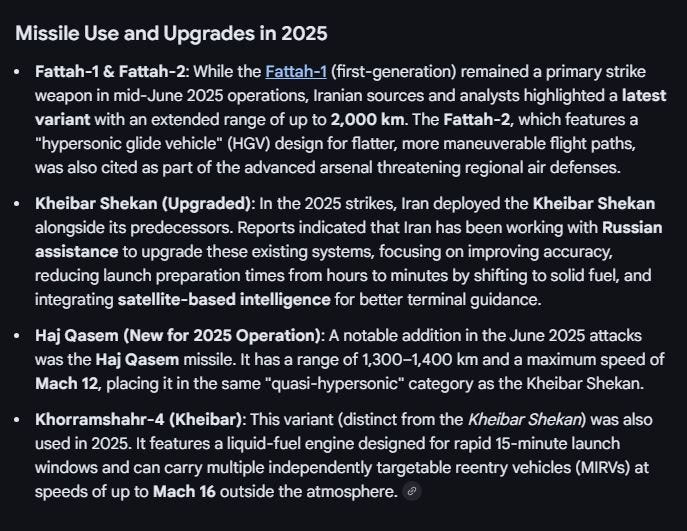
A big difference. Iran basically used the last few days of the conflict to test its upgrades – which were, as far as we can see, remarkably successful, with those successes only revealed recently.
Precision in missile strikes depends on many factors. Postol outlines the basic ones relevant mostly to conventional ballistic missiles and he does not dwell on targeting and control systems for hypersonic missiles with maneuverable warheads.
Suffice it to say, that if the record of 2024 and 2025 is any indication, Iranian missile technology is progression very fast thanks to synergy between Russian, Chinese, and Iranian technologies – a synergy which benefits all three, of course.
What does this add up to?
If there is war in the next month a lot depends on who attacks. If the US attacks, it could suffer major losses — bases destroyed, naval vessels damaged, aircraft shot down. If Israel joins— which is likely —Iran will target Israel. And Israeli civil society could cease to exist.
The Qu’ran insists on “proportionate retaliation”, which in this case, could be extreme — assuming the combined military might of the US and Israel and their long history of attacks on both Iran and Islam.
More on weapons
In the meantime, Trump has been mouthing off again about “secret weapons”…. implying he can use them in Iran as (he says) he did in Venezuela.
The Venezuelans didn’t get a chance to fire a single shot. Russian equipment didn’t work. Chinese equipment didn’t work. Everyone is trying to figure out why this happened. One day, you will find out about it
Gee! A BIG secret! So natch — I gotta tell ya’ right away, although they will withdraw my security clearance to Starbucks, which I can’t afford anyway.
He appears to be talking about the HIJENKS systems. These are Electromagnetic Pulse weapons, such as….
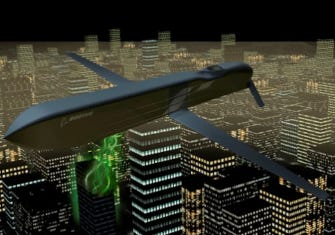
These missiles can interfere with electronic and electric systems within about a one mile range. so Russian and Chinese strategy is to detect and shoot them down before they get close.
The American version use low-flying stealthy JASSM type cruise missiles.
However, the EM pulse has a limited range of (at the most) a couple of kilometers. Russia is a world leader in EW and EM technologies so it has developed a tiered, networked system.
Obviously, Venezuela did not have technological base for such a sophisticated system — but Iran, with the help of China does. Russia was fortunate in having been able to gain access to JASSM duds in Syria and examine their electronics.
So, HIJENKS systems are a threat to Iran. But the Russians and Chinese have their own systems. Such systems have never been tested against adversaries with hi-tech competence.
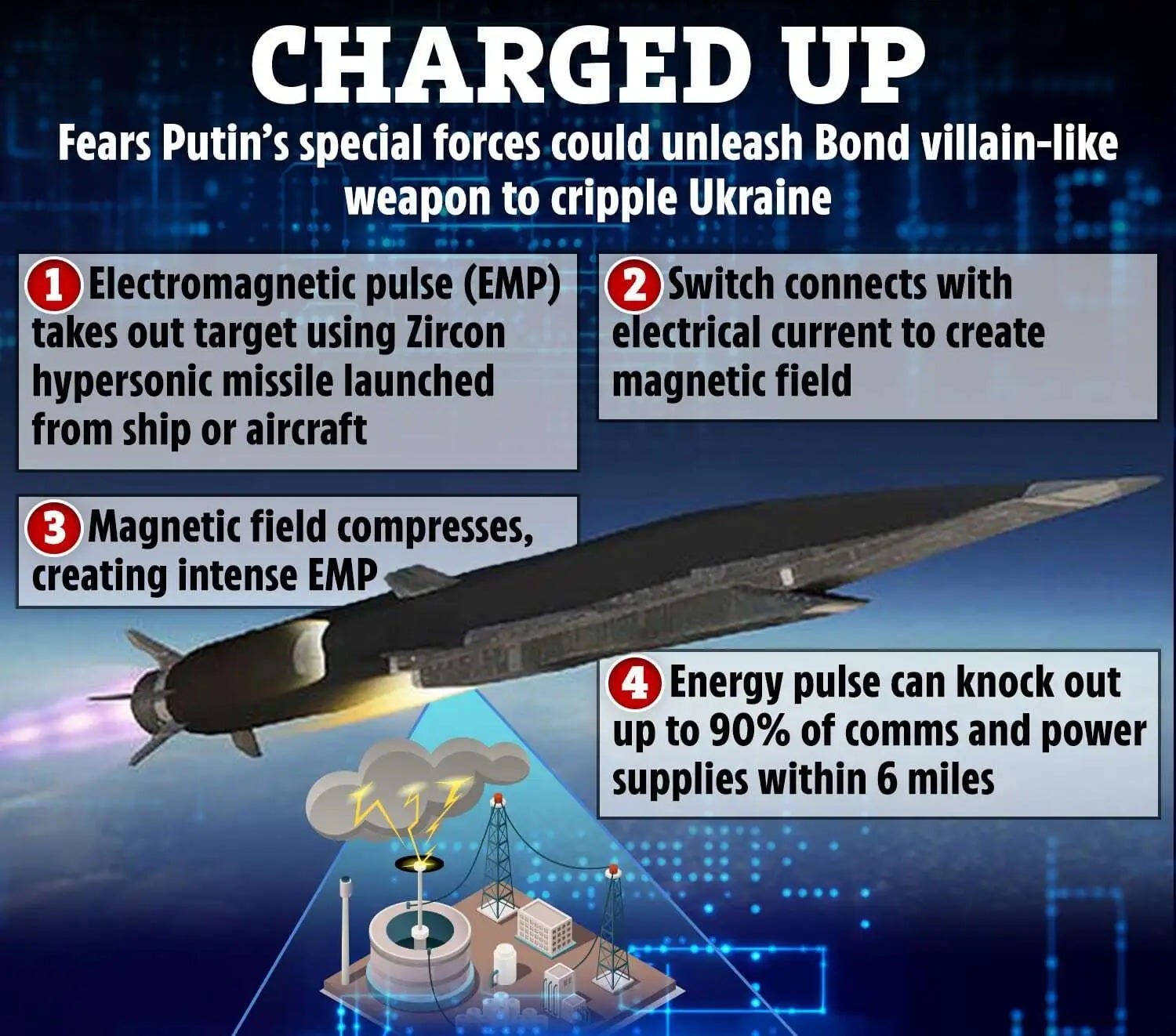
Iran has its own EMP missile —the Rastakhiz Missile, which as two warheads, one explosive, the other an EMP warhead. That implies that the EMP warhead could be grafted on other systems.
In other words, war with Iran will be no easy matter .
Paws of War
Help, help, help….

I also need help in getting new subscribers. Please crosspost, and feel free to post urls on other blogs or X or other platforms. . Every time someone does that, I get a new subscriber.
This is how we know of Putin's numerous false flag attacks on his civilian population.
Crocus City Hall attack, 149 dead and 400 injured - served to distract from russia's humiliating failures in Ukraine.
The 1100 casualties (~350 deaths) from Putin's 2004 Beslan "school siege" deflected attention from his numerous domestic policy failures.
Putin's 2009 Nevsky Express "bombing" in Novgorod Oblast failed in that GRU only managed to kill 30 "dissidents," and despite wounding over 100 more, that little dust up was out of the news within days.
Medvedev was satisfied with his 2011 Domodedovo Airport "bombing' body count (37 killed, >170 maimed), but again, that incident failed to captivate the public as had been intended.
The 2003 Stavropol train "bombing" left 46 dead and over 170 injured, reaching Putin's required body count.
Interesting that LLM should push the idea that "Modern Intercontinental Ballistic Missile (ICBM) defense systems struggle to track and intercept multiple hypersonic objects.." implying that they only have a problem intercepting multiple targets. Basically just repeating western propaganda/ copium. However, as far as I am aware, no hypersonic object has ever been intercepted except in Russian tests. If anybody has any evidence otherwise I would like to know.