Open Source Intelligence
The Rumor Mill

You no doubt have read various accounts about the ongoing SVO.
The war goes on.
Media Coverage : Propaganda Wars
The media responded to the recent attack on military installations in Ukraine focusing on Kiev — despite the fact that Russian ballistic missiles and drones also targeted military airports, airfields, and energy infrastructure in Dnipropetrovsk, Poltava, Cherkasy, Chernihiv, as well as the broader Kyiv region beyond the city.
Of course, Ukrainian sources say that the vast majority of the drones and missiles targeted the city of Kiev and civilian targets. We don’t know. But in terms of military strategy, it seems unlikely.
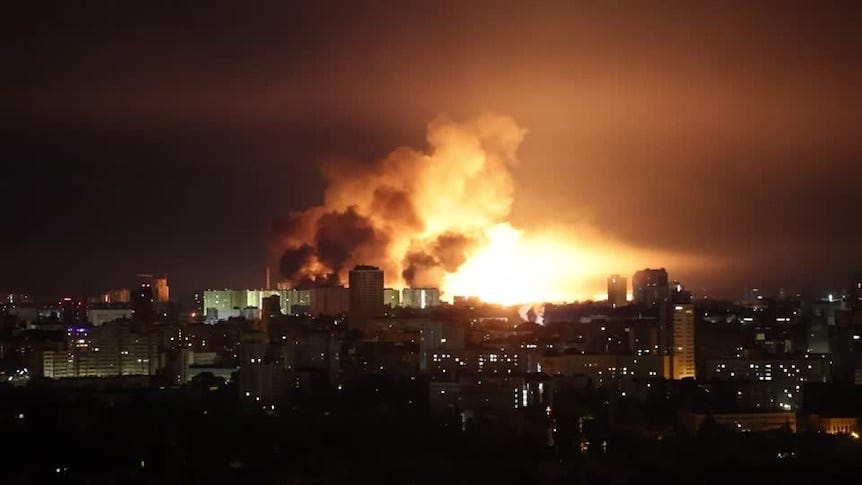
The Washington-based ISW which relies on Ukrainian sources, such as in this case Defense Express), tried to rationalize the size of the strike as a result of Russia “saving up” missiles and drones for the last few weeks, a variation of the theme: “Russians running low on…” (any number of options). In fact, huge strikes have been occurring regularly every two weeks—the beginning of June,mid June and now.
The fact is that Russia is producing thousands of drones and missiles every month.
It is spacing its attacks in order to get in-depth intelligence on targets, which tend to move around and also to maximize strategic effects. Keep in mind that the attacks are not just on Kiev—but all over the country
The fact that the Western media focus so much on Kiev tells you that the narratives originated from Kiev.
In any case, Russia is still limiting its attacks to military targets but is less concerned about collateral damage, since it is inevitable from Ukraine’s failed attempts at air defense.
Since Ukrainian propaganda is the basis for the Western narrative, think-tank’s malinformation is fed back to Russia through Telegram and other avenues to feed Russian military bloggers including the so-called “map-makers” like Rybar and Suriyak.
I say “so-called” because if you go to to their Telegram channels you don’t see a lot of maps, mostly commentary, although Rybar has as subscription channel for maps and video footage!
Keep in mind that most Ukrainians can speak, read and write Russian – and often pass themselves off as Russian.
This means that the Western “narratives” achieve indirect credibility.
Rybar
If you wondered why Andrei Martyanov hates Rybar so much, this is one reason, although Martyanov is dismissive of a lot of people and his reasons are not always obvious.
Rybar the Non-Map Maker did supply a map about the strikes on Kiev, conveniently in English, provenance unknown.
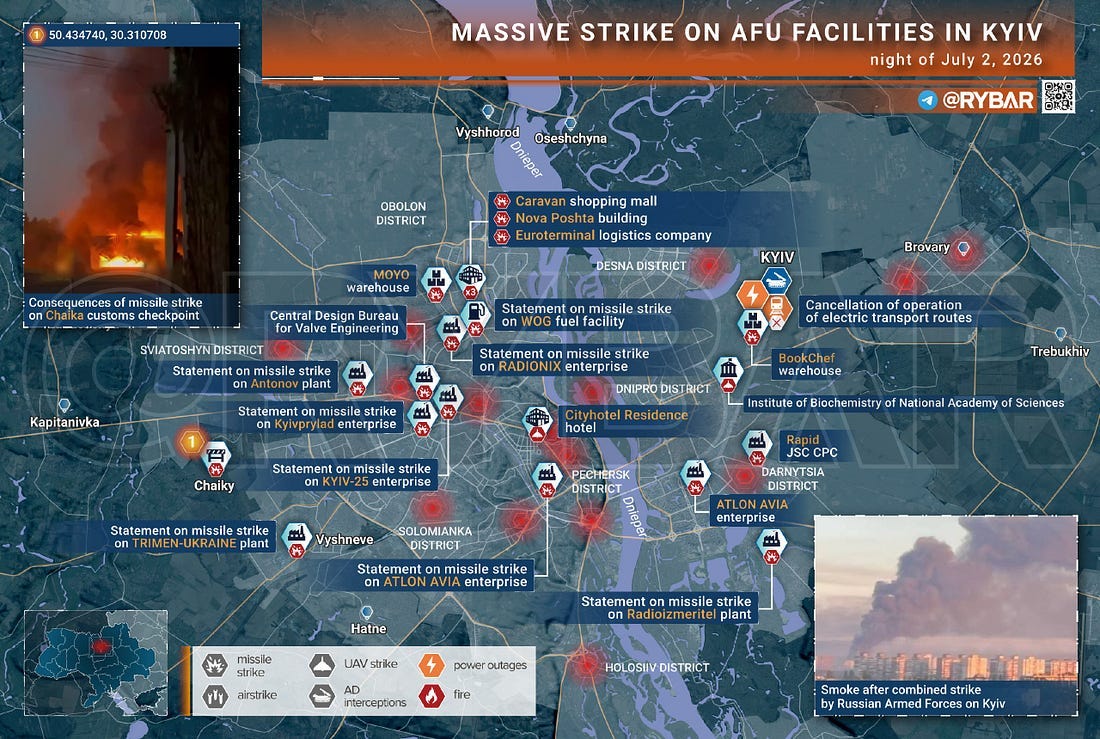
Notice that the targets appear to come from Ukrainian sources since many of them appear to be non-military, and they are identified in such a way as to make the Russians appear not to care about civilian casualties.
Yet Russia does not waste weaponry on civilian targets.
▪️Institute of Biochemistry of the National Academy of Sciences? Sounds very “educational”.
▪️A branch of “Nova Poshta”which helps supply the AFU on the front and even including delivery of armored vehicles. That’s a legit target.
▪️A warehouse of the OKWINE alcohol store chain? What monsters!! Wine lovers rise up!
The Taryan Towers business complex00 home to SBU employees.Hmmmm.
The City Hotel Residence and Premier Palace hotels, which may house foreign “specialists”. Perhaps even whole floors used as bases.
A shopping mall as a target. It seems to have been hit because it was right next to a real target.
Of course, we don’t know what was hit by Russian missiles and what was hit by failed Ukie air defense fire.
The provenance of this map and the targets is unclear– but it was not from official Russian sources, therefore most likely from the ISW and Ukrainian sources.
Suriyak
Suriyak relies heavily on OSINT, just like Rybar, especially combat footage and drone videos uploaded by brigade Telegram channels and Ukrainian soldiers and others.
However, both Rybar and Suriyak are regarded as pro-Russian. I recommend looking at both comparatively.
Both Martyanov and the Armchair Warlord (Tyler Sweeney) point out that OSINT is called “Open Source” but is as “open” to bias and manipulation as anything else.
So CIA funded media like Bellingcat or Insider rely heavily on “OSINT: as do narratives about the fake Bucha Massacre and MH117 shootdown. OSINT is basically a rumor mill which means it is VERY open to interpretation.
Martyanov, a former Soviet naval officer, is unsparing – calling the “ internet mappers”, some of whom are actually not mappers — “clowns” or “amateurs” pointing that that tracking individual tree lines, trenches, or villages on a map does not equate to understanding real military operations, logistics, or industrial warfare .
He attacks these people for “driving clicks” through sensationalism, alarmism, or premature reports.
He especially dislikes Rybar, Mikhail Zvinchuk, a protege of Yevgeny Prigozhin.
He maintains that, in the absence of real-time Russian data, these channels are frequently manipulated by active disinformation campaigns. Further, that satellite imagery and geolocated drone clips provide an incomplete and highly distorted picture of the battlefield.
The Armchair Warlord (Tyler Weaver) is also highly critical of mainstream Open-Source Intelligence (OSINT) and “warmappers”. He too includes Rybar as a “warmapper” .
Emphasizing that wars are won or lost on logistics and that OSINT mappers tend to focus excessively on static territorial changes rather than understanding role of combat power and supply. He notes that feints and shaping operations are usually characterized as military setbacks.
The Russian command is parsimonious with its reporting on the war, and Russians are born skeptics, which adds to the general confusion.
Now : the War
The focus right now is on Konstantinovka. This city falls. Then Kramatorsk and Slavyansk and Donbas are done, so the Russians can turn their attention to other areas.
Much is made of back-and-forth in Kupyansk, were the Ukrainians keep on wasting armored brigades, and the Liman area, which the Ukrainians insist is still their. Limam is certainly now mostly under Russian control but it is Konstantinovka that matters Kupyansk remains a killing field.
As early as 2024, the Ukrainian Armed Forces began to defend themselves relying on these types of fortified areas. The Kyiv regime introduced the concept of a “belt of Donbas fortresses,” which was widely promoted by Western media. Key fortresses were designated, for example, Avdiivka (liberated by Russian troops in 2024), Chasiv Yar (liberated last summer), and Kostiantynivka.
Konstantinovka stood apart from the others, as it covered the entire Slavyansk-Kramatorsk agglomeration from the south, which is now being successfully attacked from several directions.
This town was especially important for advancing northwest through the urban sprawl—to Alekseevo-Druzhkovka, then on to Druzhkovka itself, beyond which Kramatorsk and Slavyansk were already visible.
As for bunker fortification systems, they were created not only in industrial zones on the territory of former large enterprises, as was the case, for example, in Mariupol, but also throughout the entire development, including the private sector.
These bunkers are not just ordinary basements, but also stationary concrete fortifications that were to be supplied by heavy drones after the loss of normal ground logistics.
After the loss of two large factories in Konstantinovka, the enemy’s defensive system was first relocated to a block of apartment buildings and high-rise buildings nearby, and after its losses, the Ukrainian Armed Forces dispersed among the private housing sectors – specifically through a pre-installed system of bunkers.
Indeed, in theory, a single bunker like this could be defended for weeks. In practice, in recent days, the garrisons of these bunkers in Konstantinovka have begun to surrender en masse, primarily because Russian troops have cut off their supplies.
Russia, as is well known, has long and effectively employed the tactic of encircling such fortified settlements and disrupting enemy logistics. Exactly the same method—outflanking the city—was employed in the case of Konstantinovka. By late June, the process of isolating Konstantinovka had already been completed.
Furthermore, the Ukrainian Armed Forces’ tactic of creating a “drone screen” works in open areas, but it proved ineffective in the dense urban environment of Kostyantynivka. Already on Russia Day (June 12), Russian troops marked an important symbolic occasion by planting over two dozen Russian flags in various liberated areas of the city.
At the moment, units of the Russian Armed Forces are occupying the remaining small northern part of Konstantinovka (the private sector) and are completing the clearing of the already controlled neighborhoods.
The focus is primarily on eliminating Ukrainian Armed Forces units located in concrete bunkers (or basements). The Ministry of Defense reports that this operation is being carried out by assault units of the Southern Group of Forces.
The liberation of Kostiantynivka opens a direct route to Slovyansk and Kramatorsk via Druzhkovka. Advances toward the Slovyansk-Kramatorsk agglomeration are also proceeding successfully from other directions (for example, Piskunovka was recently liberated, opening the route to Kramatorsk from the east). There are also successes in Krasny Liman. The battle for the Slovyansk-Kramatorsk agglomeration, in turn, is expected to be the final battle for the liberation of Donbas from the Ukrainian occupiers – and one of the decisive battles of the entire Ukrainian special operation.
The capture of Russia’s “glass capital” will bring the liberation of Donbass closer
The war may be over soon. Zelensky is getting desperate.
One sign is that Zaluzhny, the Azov’s favorite son, has announced he is running for the Presidency.

SouthFront’s take
I will never eat a hot dog again
No, that’s not me. Just looks like me.

Support New Forensics.
And please encourage others to subscribe to News Forensics. I would love to get to 5000 subscribers.
What we never hear in the West is just how many of these hits on civilian targets are actually the result of “friendly fire” by air defence missiles gone astray. To your point, though, the Ukies have a habit of co-locating military targets near civvie centres of various sorts, much the way Israel put a command centre under a hospital.
"A shopping mall as a target. It seems to have been hit because it was right next to a real target".
I am sure I remember a shopping mall in Odessa being struck several years ago - back when it seemed likely that the Russians would move on the city soon.
There was much squawking, but sources I thought credible said that the Ukrainians had been using it to store weapons and ammunition.