The Bleeding Edge

I write a lot about advanced applied technologies and the difference in philosophy between the US and China and Russia. American technologies try to be not just “cutting edge” but “bleeding edge”. And they do indeed bleed, but not in the sense intended by the phrase — usually meaning super-advanced but rather too complex, too expensive, too new and untested, too impractical.
Ouch!

In the US, the problem is corporate rule — the state works for the corporate sector. In China and Russia, the corporate sector works for the government. Of course, in the Chinese and Russian cases that can lead to corruption - but , as you have likely seen recently, that can be rooted out and punished In the American case, corruption is hard to deal with because it is less caused by individuals thanby the system itself.
So, Elon Musk is a trillionaire. How did he get that rich? Some people mischaracterize him as an inventor. He’s not . His genius is marketing and influence and PR.
US government agencies have contributed at least $38 billion to Elon Musk’s companies (primarily SpaceX and Tesla) since 2003, through contracts, loans, subsidies, and tax credits.
SpaceX: $22 billion in government contracts, largely from NASA and the Department of Defense.
Tesla: billions through consumer EV tax credits, state/local subsidies—such as a $1.3 billion Nevada incentive package—and $11.4 billion in regulatory credits purchased by other automakers under government mandates.
The total public funding includes $2.1 billion in direct state, local, and federal grants or loans, in addition to $1.5 billion in state and local tax breaks.
Of course, Musk is not the only one. I’m singling him because he such an obvious example. And, of course, because he is a VERY interesting personality, about whom I really can’t make up my mind.
Nor is the problem capitalism per se. Both China and Russia are capitalist but they do not allow corporatism to subvert the public good . Profit is fine, but it must be earned.
Elon Musk and his most recent venture Space X is a good example of imaginative experimentalism gone wrong.
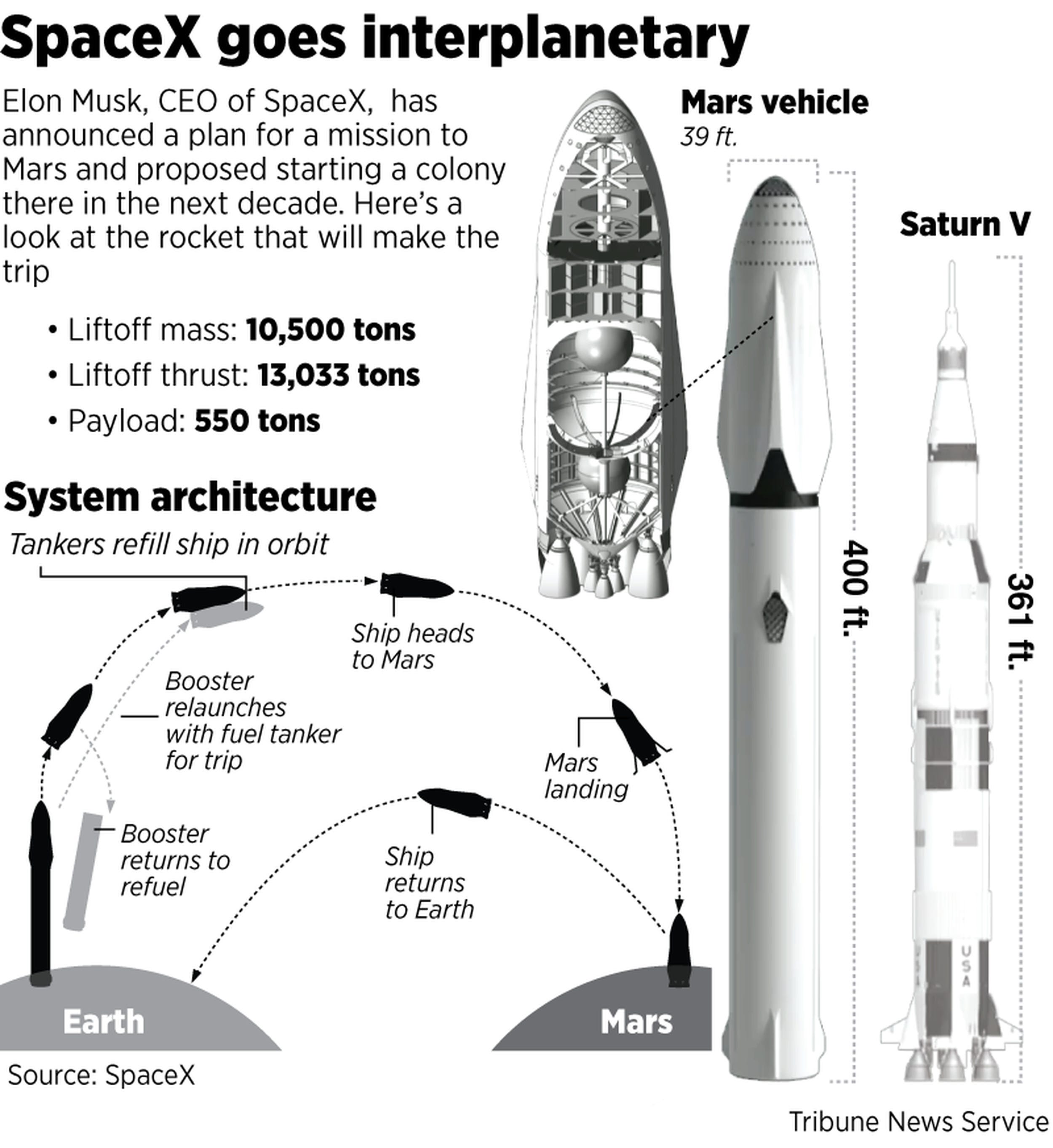
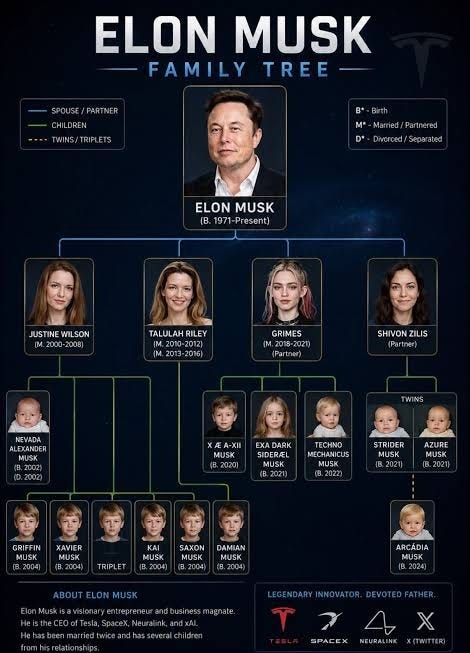
Wonderful. You can go to Mars and live underground for the rest of your life, to prevent radiation sickness, while calcium leaches from your bones and your organs fail from low gravity and you go mad. Let me warn you — Elon Musk is staying here on Earth where he has four non-wives and 14 kids.
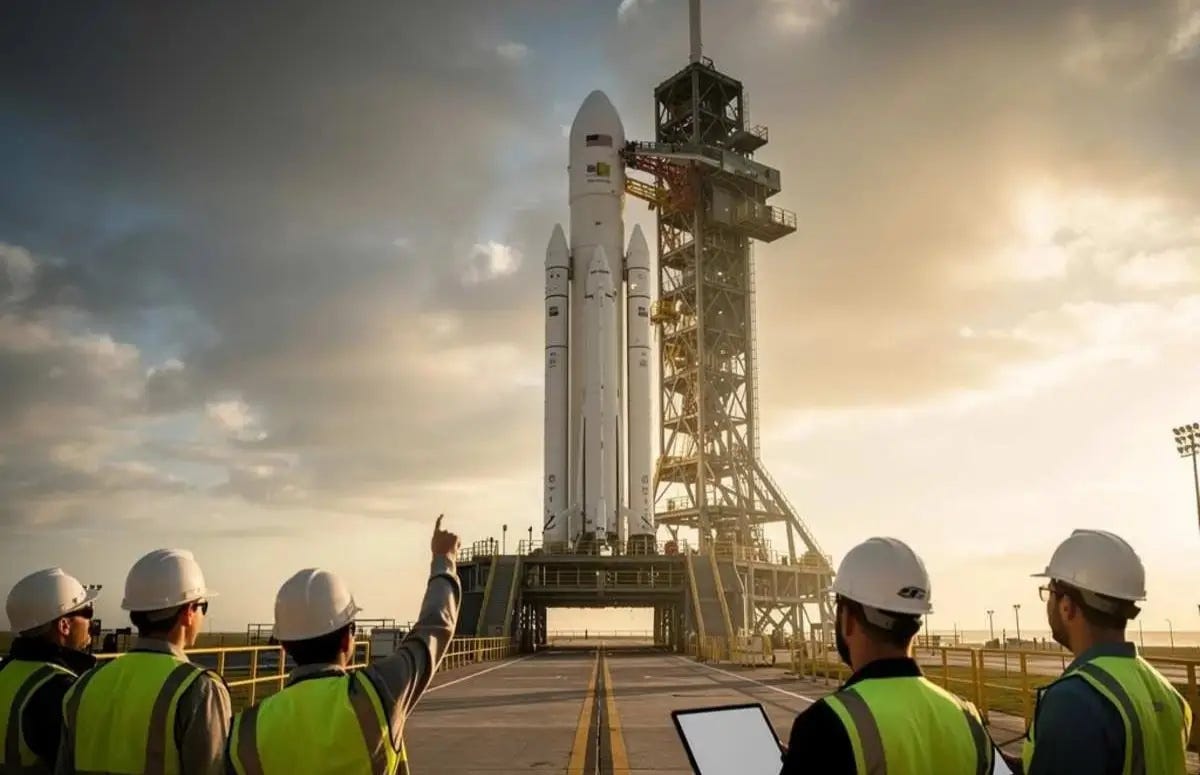
Space X is a Dud.
This part of my article is based on one appearing in the Russian press, which relied on Western sources, which I checked and provided links for.
Shares of Elon Musk’s SpaceX , a month after its initial public offering (IPO) on Nasdaq and the explosive rise that made Musk a trillionaire, have fallen below their IPO price.
The company’s 124-meter-tall, high-power Starship spacecraft is a dud. Maybe it won’t always be but it will need billions to put right. So far, $15 billion has been invested in its development
Its 13th test flight recently had to be aborted due to technical problems
The stock’s decline then accelerated after the investigation by the US Federal Aviation Administration (FAA) became public identifying a host of problems. Space X’s extensive multimillionaire PR campaign also failed.
“When a company’s shares fall below their IPO price within days or weeks of the first day of trading, it destroys the picture carefully crafted by the company and its bankers. Shareholder losses at such an early stage are a blow to confidence from which some newly listed companies struggle to recover, “ writes Bloomberg .
Influential investor and founder of investment firm Noble Capital Partners, George Noble is convinced that SpaceX ‘s valuation is disconnected from its fundamentals and that the stock’s rise was fueled by artificial hype, which s.ubstantiates claims by other investors hinted that the IPO was a scam.
The Chicago-based financial services firm The Morningstar say the company is overvalued by 169% and set a target price of $63 (more than half the current $132) given that launch problems are unlikely to be resolved for a decade or more.
Complicating things is that SpaceX has three divisions : space, communications, and artificial intelligence.
According to Forbes Starlink is SpaceX’s only profitable division.
The space division generated a loss of $657 million last year and xAI lost $6.36 billion. So, despite its name, SpaceX is really now just Starlink—a system that will soon be facing real competition from Russia and China in the huge Asian market, which may cause its profits to sag.
SpaceX engineers are frantically trying to fix Starship V3 . But they lack an engine that can launch over 100 tons of payload into low-Earth orbit.
The workaround is to use multiple lower-power Raptor engines .
However, the vibration levels of piping and engine suspensions are so high the structural integrity is compromised and existing materials and design solutions are unable to provide the necessary rigidity for the entire structure.
That’s why so many of the test launches of Raptor-powered Space X have ended in explosions.
Space X v. 3 suffered a similar fate leading the world’s aerospace community to question the technical competence of SpaceX engineers .
Press coverage is not favorable.
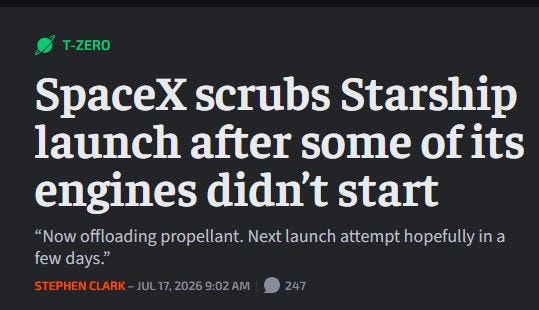
And Futurism.
Shares dipped below a bruising $120 before trading stopped on Monday afternoon, a new record low that’s well below SpaceX’s IPO price of $135. That means the plummeting stock has wiped out almost half of its value compared to its all-time high, representing over $1 trillion in market cap. Anybody who bought shares after the IPO is now officially underwater.
It’s not difficult to come up with reasons behind the company’s ongoing stock market troubles. As SpaceX’s years-long struggle to develop its super heavy launch platform demonstrates, Musk’s ambitions for the company are largely built on hopes and dreams, from orbital data centers to a city on Mars, which are cool sci-fi concepts but entirely unproven in the real world.
Space X claims to be working on workarounds , which mostly focus on the low payload capacity of the first two versions of Starship.
Let’s say you just want to go to the Moon, which is a LOT easier than Mars.
So far, Starship can’t do a direct flight to the Moon—it first needs to stop and refuel in orbit.
The Starship Human Landing System (HLS) is SpaceX’s specialized lunar lander variant of the Starship spacecraft, selected by NASA as the primary vehicle to return astronauts to the lunar surface for the Artemis program. 50 meters tall with a 9-meter diameter, the HLS is much larger than previous lunar landers and needs a huge amount of propellant to travel to the Moon.
Full filling of HLS cryogenic fuel – 100 tons.
Starship V2 transported only 16 tons during suborbital flights. SpaceX claims the ability to deliver 35 tons to LEO, but this is a far cry from the 100 tons required for orbital refueling, without which this entire orbital refueling process would take too long.
Filling requires launching 15 or more Starship tankers into Low Earth Orbit (LEO) within a tight window to load an orbital fuel depot before the cryogenic propellants boil off. It is doubtful if SpaceX can scale up its launch cadence quickly enough to sustain this.
Once in lunar orbit, it docks with NASA’s Orion spacecraft, transferring the crew to descend to the Moon.
Complicated? Expensive? Buggy?
Elon Musk says he is solving this problem, but slowly. Not him actually He holds bachelor's degrees in physics and economics from the University of Pennsylvania.
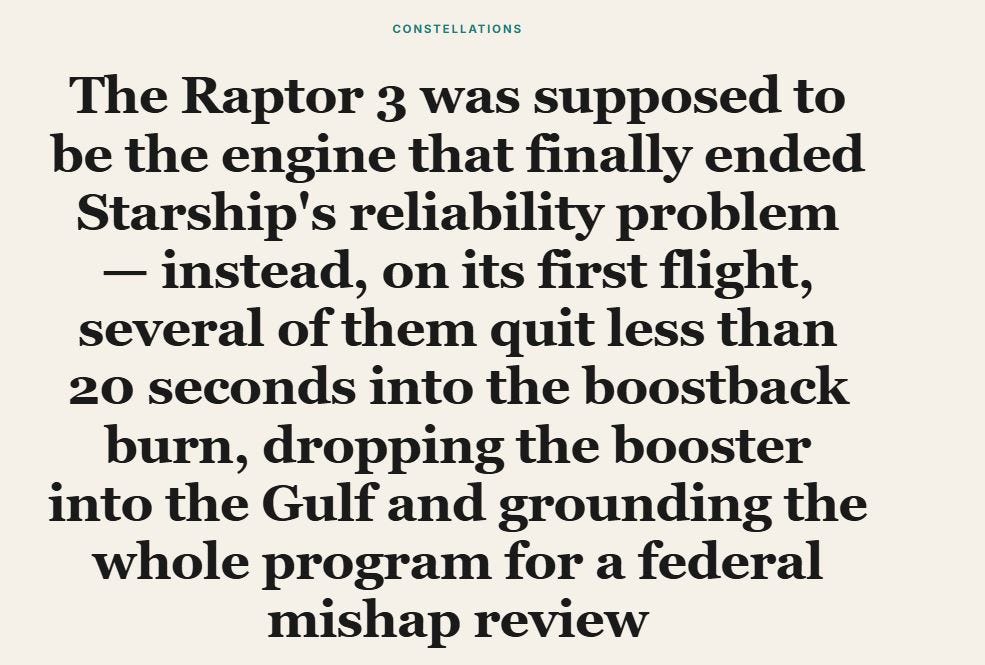
Engines are basic to Starship V3’s problems — new SpaceX Raptor 3 engines . By removing the heat shield and shifting to more extensive use of ablative cooling (where cryogenic propellant cools the engine before combustion), the Raptor 3 is 105 kg lighter than the previous Raptor 2 – a saving of over four tons per rocket.
The Raptor 3 has become more powerful: the rocket’s overall thrust has increased by 9%. Furthermore, the Starship V3 carries 12% more propellant than the V2, and its upper stage is 6% larger. This required the V3 to be significantly longer than the V2, but its dry mass is reportedly 20-30% lighter, or approximately 100 tons.
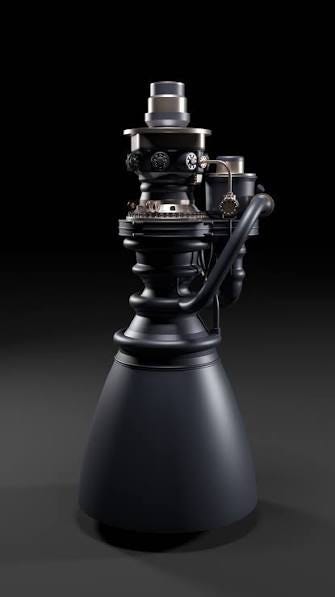
All of this should, according to SpaceX engineers, increase the Starship’s payload capacity , but what has been achieved is, as we have seen, nowhere near enough.
So.
SpaceX is increasing the Starship V3’s payload capacity by increasing engine power, increasing the ship’s size and lightening its hull.
Problem? This, as indicated, inevitably leads to a reduction in the strength of the entire ship’s structure, which, is already compromised. And it still doesn’t achieve the necessary payload.
Space X therefore needs not only new engines but :
super strong materials
built in vibration resistance
These things tend to increase weight and decrease payload.
Without this the Starship/Super Heavy complex is unviable .
EVs are simple technologies. “Starships” are not.

And it is doubtful if multiple engines are the answer. It’s not a new idea.
From Space Daily….
So you want to go to Mars….LOL
Musk is not an engineer.
His solution is to manipulate the stock market, to extract billions from investors to buy his way to improving his monstrous brainchild.
He’s good at that. That’s why he is the first trillionaire on planet Earth.
But who knows. Maybe he will succeed.
Support New Forensics.
Help Ichi and Chappy and the guy who struggles with cat toilets, much less building starships. Ichi and Chappy are the Engineers .

I would really like to get to 5000 subscribers. If you like my work, share the urls on other blogs and sites and in comments on podcasts.
Show us you care by buying us coffee at https://buymeacoffee.com/julicow
"So, Elon Musk is a trillionaire. How did he get that rich? Some people mischaracterize him as an inventor. He’s not . His genius is marketing and influence and PR".
Just like Steve Jobs, Bill Gates, Larry Ellison, and so many others.
Spot the f—k on!
Our man Elon has a physics degree and a degree in ECONOMICS. THE LATTER IS PAYING OFF IN SPADES..
His Starlink subsidiary is a moneymaker, at least in part, because the Intelligence Community relies on it to do those spying things the IC relies upon to keep pace with Russia , China and Iran.
And his DOGE bit gave him access to all sorts of info at Treasury and the IRS.
Old Elon, when he’s not procreating willy-nilly, keeps himself essential to the Deep State and informed on other matters. It’s more than a wee bit of CYA (cover your ass), it’s staying ahead of the competition.
A lesson learned in Economics 101.