War 101
A primer on conflict

What wins wars?
What wins any conflict?
First— surprise.
Second—adaptability . Which includes willingness to change tactics to take advantage of opportunity.
Examples from martial arts
Let me give you an example.
When I began studying karate, I had already done judo and a bit of jiu jitsu, both of which are close-in grappling arts. By contrast, karate requires a certain distance and the use of dynamic strikes with the legs and hands, designed to incapacitate with a single blow.
Shodokan karate, like other styles, emphasizes sparring. And novices are often pitted against more experienced fighters to learn what to do — and what not to do.
In my first sparring practice, I was one of two novices pitted against two higher belts.
My opponent took his stance outside striking distance and I saw from his movements he knew what he was doing. He was confident because he could kick or punch and there was nothing I could do about it.
He moved forward into attack position, transferring weight onto one foot so he could kick with the other or perhaps strike with the hands or probably both.
He stepped forward and I swept his foot. He went down—and I won.
Surprise works.
But I still lost the sparring session because the other fighter had seen what I had done. I could not repeat the same trick twice. And he hit me with a spinning reverse roundhouse to the throat.
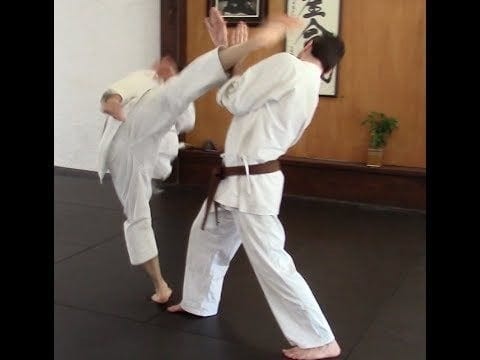
This kick entered Shodokan in the 60s from northern Chinese kung-fu and was later popularized by Chuck Norris.
It is showy, good for movies but actually a high risk, low reward kick, suitable really against an inferior opponent, which I definitely was.
Distance matters
On of the main counters to this kick is distance. Either close or far.
But that is always the case in combat — position, distance. My first success depended on using distance and position so my opponent would come to me, aware I could mount no conventional defense. My defense was not usual — but still within the rules.
With my second fight, I had never seen a reverse roundhouse before – as was the case with most people in the 60s and 70s. And I had lost the advantage of surprise.
No matter.
The US sneak attack on Venezuela relied on surprise. No one on the internet it seems quite gets that it was a sucker punch. So they assume the CIA bought off the Chavista military like they did the Syrians or the US had some secret weapon as Trump keeps on saying.
Don’t count out luck
Putting aside the whole idea of subversion, which was the recent US-Israeli gameplan in Iran and failed, the US traditionally relies on its nominal superiority in conventional military capability.
However, American weaponry has time and time again proven vulnerable to Russian systems and therefore likely to Chinese systems – not to mention to Iranian systems during the 12 Day war.
Naturally, the Americans deny this — for obvious reasons— among them weapons sales. They insist that Patriot systems are swatting Russian hypersonic missiles like flies, which is why they have to keep on supplying more and more Patriots to make up for the ones destroyed. By accident maybe? Or maybe because Russian flies are big and nasty.
Despite what people like John Helmer say, relying I think on Western media accounts, the Israelis operated outside Iranian airspace with standoff weapons and and the B2 strike seems to have gone unopposed with the bombers dropping their biggest, baddest bomb to little effect. See Larry Johnson’s site for details.
The Iranians gave the Americans a face-saving win— but also demonstrated the limits of Yankee Doodle Do-Do. That bombing did negligible damage. But the Iranians wanted a break. The 12 Day war had taken the Iranians by surprise and while they had recovered quickly they needed time to adjust to a new situation.
The Iranians had just demonstrated the limits of Israeli power with a dozen or so hypersonic missiles in the last days of the war, penetrating Israel’s much vaunted, multilayer air defense system, which used the latest American technology .
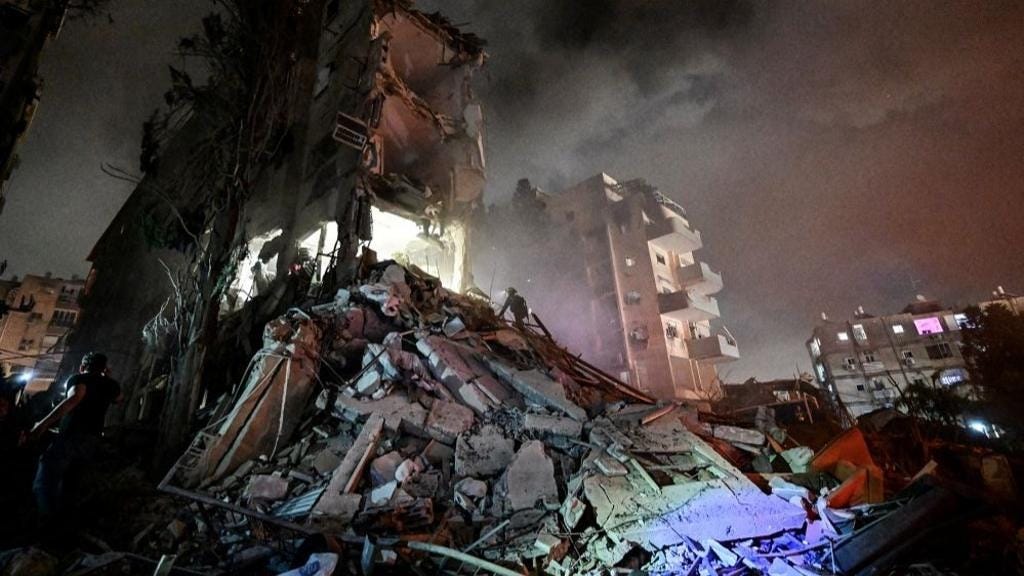
Since Trump missed his chance to resolve issues in the ME after the 12 Day War, he is now escalating—but without the advantage of surprise which he enjoyed with his snatch&grab attack on Venezuela, which, among other things, exposed US EW capabilities for which Russia and China have surely provided the Iranians with countermeasures.
Also the Venezuelans had no means to retaliate. No Americans died.
But the Iranians can retaliate and if they do, there will be lots of dead Americans. .
In military terms, Iran is a “near peer” adversary. weaker than the US but on home turf. Position matters. Making the enemy come to you matters. It confers “operational advantage”.
While Iran’s operational missiles cannot reach the US homeland, their ranges cover much of the Middle East, including US military bases in the Gulf Cooperation Council (GCC) states, naval forces in the Persian Gulf and Gulf of Oman, and allied capitals such as Jerusalem and Amman.
The mix of ballistic and cruise missiles with solid-fuel propulsion, which allows quicker launch and repositioning, presents a multi-domain threat across land, sea, and potentially air defense networks.
Ballistic missiles such as the Shahab-3 and Sejjil could threaten bases in Qatar, Kuwait, and the UAE within minutes, while cruise missiles like Ya-Ali and Soumar could complicate defense systems by exploiting low-altitude flight paths and radar blind spots.
Anti-ship cruise missiles such as Ra’ad and more distant range cruise systems could endanger US carrier strike groups and amphibious forces, especially in chokepoints like the Strait of Hormuz where Iran’s geography gives it strategic advantage
A pity Trump does not remember the fate of the Spanish armada. But the US naval “armada” is still some distance from Iran—he has time.
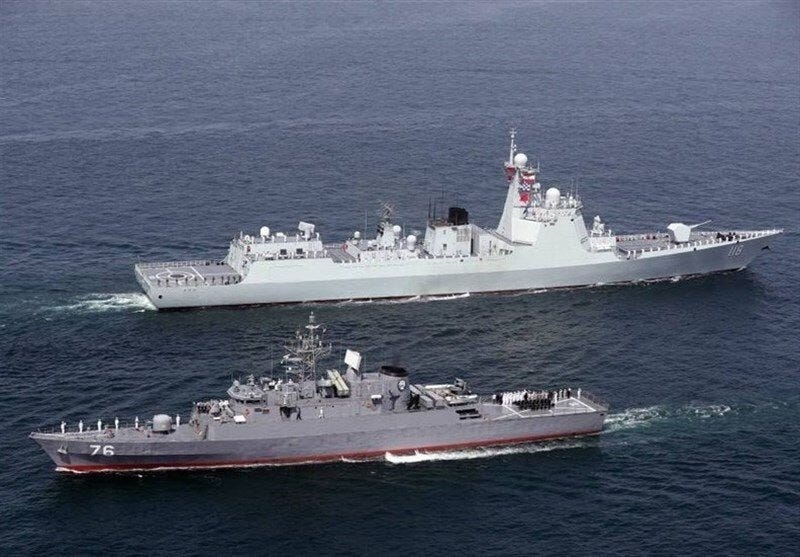
The Iranian, Russian and Chinese navies are scheduled to carry out a joint combat drills in the Indian Ocean in mid February— which the Americans will have to monitor — although this allows their opponents to gain knowledge of US electronic systems— in order to program their own EW systems accordingly.
For example, since the F35 relies heavily on complex electronic systems, it immediately becomes more vulnerable, as do Growler EW aircraft once their electronic signatures are identified .
The US cannot attack while the Russian and Chinese navies are there, which means the US carrier has to spend longer time on station along with its escorts. This not an advantage and the task force will be under constant observation by Iranian drones.
At the same time, the Iranians, Russians and Chinese will be sussing out American and Israeli ISR including satellite and AWACS feeds while identify targets throughout the Middle East. .
All this does not mean that war against the US would be a slam dunk for Iran.
Just that it definitely would NOT be a slam dunk for the Americans— even with help from the CIA/ MOSSAD and assorted terrorist groups such as MEK inside Iran.
At his point, it’s a horse race . Place your bets.
Addenda:
The MSM point to the ability of the US Carrier Group to maneuver and point to the Iranians’ rather primitive real-time targeting. However, the Iranians can get targeting help from drone systems and other means.
Hypersonic missiles’ descent time is under 30 seconds and these weapons dive close to vertical making interceptor missile defense difficult.
Carrier groups could make targeting difficult by maneuvering —except that combat maneuvers take over a minute, usually 2 or three. That means having to rely on point defense systems whose maximum elevation is just over 80 degrees. So are not as effective for a missile coming straight down.
Point defense systems work better for cruise missiles. But they have a maximum continuous firing time of about 20 seconds. And ships can carry only 6 to 8 reloads.
That means that drone swarms and cruise missile attacks could quickly exhaust the task forces’ ammunition. The Iranians have a HUGE arsenal!
Unless the US can take out Iranian launchers, it is in trouble.
Something to take your mind off war
Chappy and Ichi think that there is nothing better than friendship.
If you just read the news, it can be depressing There are so many terrible things happening, cruel and monstrous things. But there are good things too. Kindness. Love and friendship. Things to laugh about, as well as cry about. I try to look for the goodness in small things.
I am just an autistic toilet guy. So, why not?
Buy us coffee at https://buymeacoffee.com/julicow. Click here !
I don't want to see any American military killed but I'd love nothing more than to see at least one of those aircraft carriers sank by the Iranians. Sadly in conflicts nothing like that happens. I do get pissed off at American Military acting all brave & heroic after attacking defenceless opponents though.
Thank you for your splendid explanation of the current situation in the Gulf of Oman, at the entrance of the Persian Gulf.
It is now Sunday Februari first 20:00 o'clock (CET). No sign of arm usage yet. When he starts using weapons now, Wallstreet will show panic-inducing figures, and that is unacceptable.
There are Chinese (and probable Russian) Naval units (including Subs) near the Strait of Hormuz where they have placed an International 'Great Power Shield', Joint Maneuvers that Turned the Tables... Trump Faced Two Options: Immediate Strike or Forced Postponement. So he appears to have chosen 'Forced Postponement'...
What a beautiful narrative will he use to explain his failed attempt to surprise Iran with a blockade of the Strait of Hormuz ? Bets are up !
Cassandra